.jpg)
Subscribe to the LONGi Newsletter

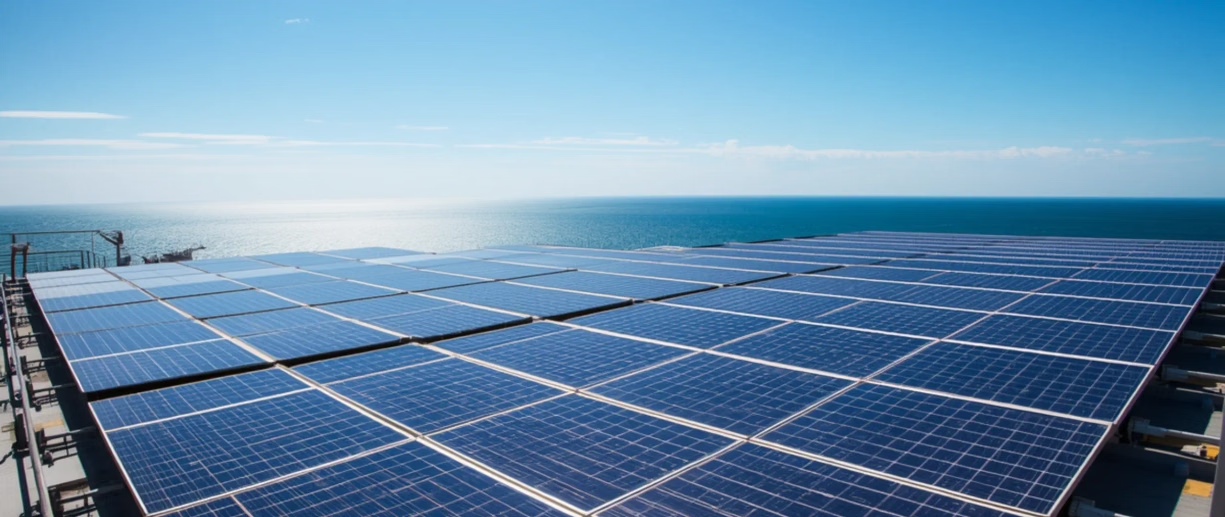
Field tests in Sanya, Hainan Province, China, found that LONGi’s HPBC 2.0 modules generated 2.03% more specific energy yield than the tested TOPCon modules under unshaded conditions. Under column shading, the difference increased to 14.96%. The comparisons examined module performance in both scenarios under outdoor conditions.
Two comparisons examine energy yield with and without shading
Thestudy compared LONGi HPBC 2.0 and TOPCon modules in separate unshadedand column-shaded test groups. The setup comprised four module arrays, with 10 HPBC 2.0 modules and 10 TOPCon modules in total across thetwo groups. Specific energyyield, measured in kilowatt-hours per kilowatt-peak (kWh/kWp), was used tocompare electricity generation relative to installed capacity.
In the unshaded comparison, conductedfrom 1 January to 24 March 2025, HPBC 2.0 modules recorded a specific energyyield of 320.86 kWh/kWp, compared with314.47 kWh/kWp for TOPCon modules, a difference of 2.03%. The column-shading comparison ran from 7 January to 2February 2025. In this test, HPBC 2.0 modules generated 69.848 kWh/kWp, while TOPCon modules generated 60.756 kWh/kWp, giving HPBC 2.0 a 14.96% higher specific energy yield.
Partial shading can cause current mismatch within a PV module, reducing its energy output. Bypass diodes canlimit this effect by bypassing affected cell substrings, but may also prevent unshaded cells within those substrings from contributing to power generation. LONGi HPBC 2.0 incorporates Shading Optimizer and Weak Conduction Design to help mitigate shading effects. The test results showed a larger difference in specific energy yield between the two technologies under column-shading than under unshaded conditions.
CGC verification confirms higher HPBC 2.0 yield under both scenarios
Acceptance testing for the project was carried out by the China General Certification Center (CGC), an IECRE-accredited certification and inspection body and an IECEE-accredited National Certification Body and CB Testing Laboratory. Established in 2003, CGC uses a testing methodology that combines laboratory performance testing with real-world field data. Its outdoor test bases, which span multiple climate zones across China, are equipped with high-precision sensors for monitoring irradiance and temperature. The resulting data provides a reliable reference for assessing module performance in installations where structural elements may cause shading.

Lorem ipsum dolor sit amet, consectetur adipiscing elit. Suspendisse varius enim in eros elementum tristique. Duis cursus, mi quis viverra ornare, eros dolor interdum nulla, ut commodo diam libero vitae erat. Aenean faucibus nibh et justo cursus id rutrum lorem imperdiet. Nunc ut sem vitae risus tristique posuere.