Subscribe to the LONGi Newsletter

Tests by TÜV Rheinland and CPVT examine how LONGi's HPBC 2.0 technology responds to partial shading, with results showing lower local temperatures and reduced power loss compared with the tested TOPCon modules.
Partial shading is difficult to eliminate completely from solar installations. Fixed structures can often be considered during system design, but leaves, bird droppings, snow and dust can temporarily shade individual cells during operation.
The physical area affected may be small, but the electrical effect can extend beyond the shaded area. When a cell receives less irradiance than surrounding cells, the resulting current mismatch can reduce module output and cause electrical energy to be dissipated locally as heat. Severe hot spots can accelerate material degradation and affect long-term module reliability.
Independent testing by TÜV Rheinland and China's National Center of Supervision and Inspection on Solar Photovoltaic Product Quality, CPVT, has examined how LONGi's HPBC 2.0 technology responds under these conditions. The results show lower power loss and substantially lower local temperatures compared with the tested TOPCon modules.
Cell-level current management changes the response to partial shading
HPBC 2.0 combines LONGi's Back Contact cell architecture with its Weak Conduction Design. The design allows individual cells to manage their current path when partial shading occurs.
Instead of relying solely on the module's conventional bypass diodes, internal current shunting allows current to bypass the affected area without activating the bypass diode. This is designed to keep the electrical impact more closely confined to the shaded area and allow more of the unaffected cells to continue contributing to module output.
This distinction matters because conventional module bypass diodes operate at substring level. A localised shadow can therefore affect the electrical contribution of a considerably larger section of a module.
TÜV testing records hot-spot temperatures up to 60°C lower
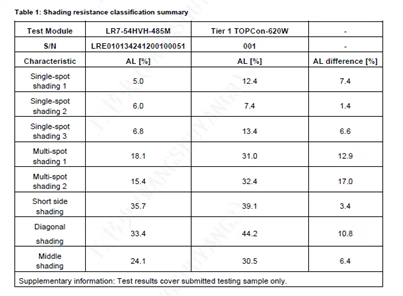
TÜV Rheinland compared HPBC 2.0 and TOPCon modules under identical shading conditions, examining both power attenuation and local temperature behaviour.
Local temperatures on the tested TOPCon modules exceeded 160°C, while HPBC 2.0 remained at around 100°C, with hot-spot temperatures up to 60°C lower. HPBC 2.0 also showed significantly lower power attenuation under the same shading conditions.
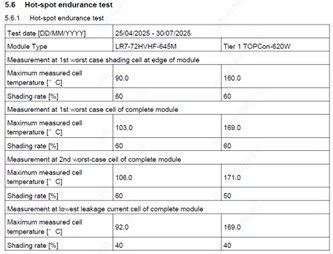
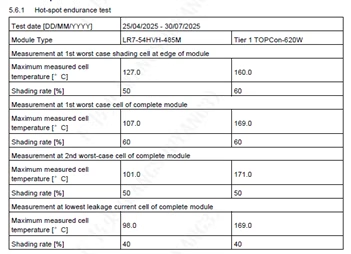
The thermal result is relevant beyond immediate module output. When electrical energy is dissipated as heat in a shaded cell, sustained high temperatures can increase thermal stress on cells and module materials. Limiting this temperature rise can therefore contribute to long-term module reliability as well as performance under shading.
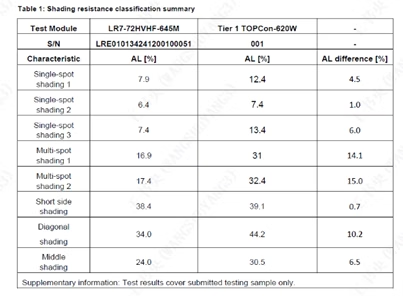
Hi-MO X10 has also received TÜV Rheinland Class A certification for shading resistance under its 2 PfG 2926 testing specification. The certification provides independent assessment of the module's response under defined shading conditions.
CPVT testing shows around 70% lower power loss under single-cell shading
Separate CPVT testing quantified the effect on module output. When 50% of a single cell was shaded, Hi-MO X10 recorded an average power loss of 10.15%, compared with 36.48% for the tested TOPCon modules. This corresponds to around 70% lower power loss under the tested shading condition.
The comparison illustrates the difference between the sunlight physically lost because part of a cell is covered and the additional electrical loss that can result from current mismatch within the module. HPBC 2.0's Shading Optimizer is designed to limit this wider electrical impact.
CPVT subsequently awarded Hi-MO X10 its “Three-Proof” certificate covering fire protection, shading resistance and anti-dust accumulation performance.
Complex rooftops put shading performance into practice
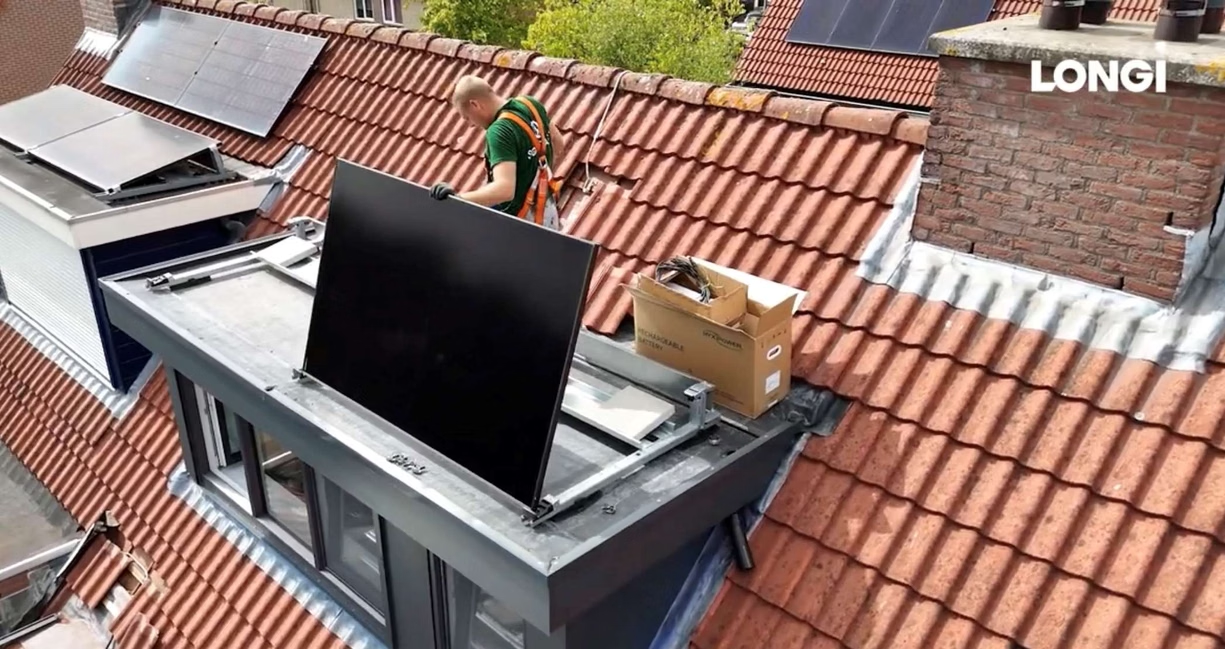
The effect of partial shading is particularly relevant for commercial and industrial rooftops, where ventilation equipment, lightning protection systems, neighbouring structures and other installations can create fixed or moving shadows.
At Shanghai AB Food & Beverages Limited, producer of the Ovaltine brand, ventilation ducts and lightning rods create localised shading across parts of the roof. The company selected Hi-MO X10 for a 670 kW rooftop PV system. According to project data, the installation saves more than CNY 870,000 in electricity costs annually.
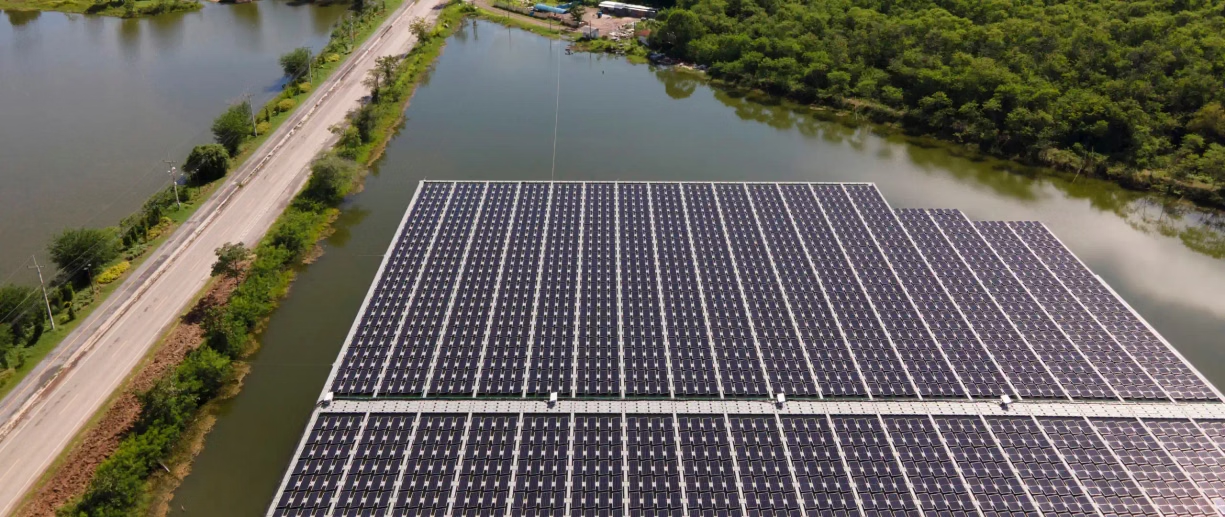
A second installation at Chumponwarin Part., Ltd. in Thailand presented a different shading scenario. Grid wires crossing the factory roof were identified as a source of shading during the project assessment. A 974.08 kW system using Hi-MO X10 was subsequently installed with local EPC PPE Solar. According to project data, the system saves around THB 400,000 per month, equivalent to approximately one fifth of the facility's previous electricity expenditure.
These projects do not replicate controlled laboratory testing. They illustrate the type of rooftop conditions in which the electrical response to partial shading becomes relevant to system design and operation.
Shading response becomes part of long-term module performance
Module efficiency under standard test conditions remains a central performance metric, but installed PV systems rarely operate under uniform irradiance throughout their lifetime. The way a module responds when individual cells are temporarily shaded can therefore influence both energy yield and thermal stress.
The TÜV Rheinland and CPVT results examine these effects separately. TÜV testing shows the difference in local temperature behaviour and power attenuation, while CPVT testing quantifies the difference in module power loss under a defined single-cell shading condition.
For HPBC 2.0, the results provide evidence of the role played by cell-level current management within LONGi's Back Contact architecture. By containing the electrical impact of partial shading more closely to the affected area, the technology is designed to retain more available power while reducing localised heating.

Lorem ipsum dolor sit amet, consectetur adipiscing elit. Suspendisse varius enim in eros elementum tristique. Duis cursus, mi quis viverra ornare, eros dolor interdum nulla, ut commodo diam libero vitae erat. Aenean faucibus nibh et justo cursus id rutrum lorem imperdiet. Nunc ut sem vitae risus tristique posuere.