Subscribe to the LONGi Newsletter

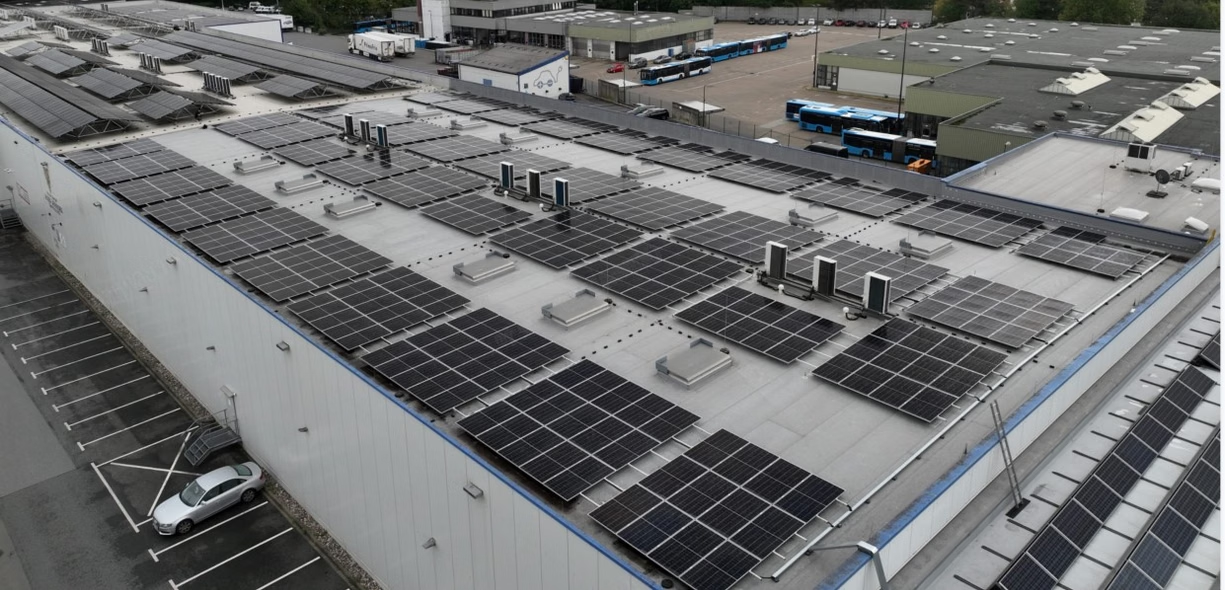
German fruit and vegetable distributor Josef Jenniges GmbH & Co. KG has installed a 385 kW rooftop solar system at its warehouse in Wuppertal using LONGi Hi-MO X10 Guardian Light Design modules. Founded in 1924, Jenniges has grown from a family-run market trading business into a modern fresh-produce distributor with extensive storage and logistics operations. The latest photovoltaic installation, completed in August 2026 by local EPC Enteria Energietechnik GmbH, uses approximately 720 lightweight modules to accommodate the warehouse roof's limited load-bearing capacity.
Jenniges combines 100 years of business history with modern energy infrastructure
When Jenniges began trading fruit and vegetables at weekly markets in Wuppertal in 1924, its business looked very different from the wholesale and logistics operation it runs today. Over more than 100 years, the family-owned company has expanded its activities to include the import, quality control, storage and distribution of fresh produce. Its Wuppertal premises now cover approximately 16,500 m², a reflection of the infrastructure required to supply modern food retailers.
The development of the site has also brought new requirements for energy and building infrastructure. In 2017, Jenniges expanded its premises by 4,000 m², including 800 m² of refrigerated space. That same year, the company installed a 480 kWp rooftop photovoltaic system, one of the largest solar installations in Wuppertal at the time. A further 226.8 kWp system followed in 2022, with a projected annual electricity output of approximately 200,000 kWh.
The continued investment in rooftop solar is particularly relevant for a fresh-produce business, where refrigeration, storage and logistics operations require a reliable electricity supply. For the 2026 project, the roof's available load capacity influenced the choice of solar modules. Large warehouse roofs can offer considerable space for electricity generation, but their supporting structures may have limited capacity for additional weight. Conventional photovoltaic systems can therefore require reinforcement before installation, which adds construction work and cost.
Enteria selected LONGi Hi-MO X10 Guardian Light Design modules, which weigh 16.3 kg each, approximately 30% less than conventional single-glass modules. Across the approximately 720 modules installed, the combined module weight amounts to around 11.7 tonnes. An equivalent number of conventional reference modules that weigh 30% more would add approximately five tonnes to the roof. The comparison covers module weight alone, while the structural assessment of a complete installation must also account for mounting systems, wind and snow loads.
LONGi Light Design combines low weight with high solar efficiency
The reduced weight of Guardian Light Design comes partly from its construction. LONGi uses 1.6 mm semi-tempered front glass and an aluminium alloy frame. Despite its dimensions of 1,990 × 1,134 mm, the module weighs just 7.2 kg/m². It delivers up to 560 W of power and achieves an efficiency of up to 24.8%.
The module uses LONGi's HPBC 2.0 back contact technology. Conventional solar cells have electrical contacts on their front surface, where they block a certain amount of sunlight. HPBC 2.0 places these contacts on the rear, which leaves more of the cell surface available to absorb sunlight.
LONGi's HPBC 2.0 technology also features Weak Conduction Design, which helps modules maintain higher power output when parts of their surface are shaded. It allows electricity to flow around affected cells, reducing energy losses and preventing excessive heat buildup, known as hotspots. In comparative laboratory tests, Hi-MO X10 modules recorded approximately 70% lower power losses under partial shading than conventional TOPCon modules. The technology also reduces hotspot temperatures and the risk of long-term cell damage. This is particularly relevant for warehouse roofs, where ventilation equipment and other structures can cast shadows on solar panels throughout the day.
Lower module weight does not come at the expense of mechanical durability. Despite weighing just 16.3 kg, Guardian Light Design is tested for front-side static loads of 3,600 Pa, equivalent to approximately 367 kg per square metre or the weight of around 3.6 metres of light, freshly fallen snow at an assumed density of 100 kg/m³. Its rear-side load rating of 2,400 Pa demonstrates resistance to upward pressure caused by wind suction, while hail impact testing with 25 mm hailstones travelling at approximately 83 km/h provides further evidence of weather resistance. For warehouse owners such as Jenniges, this combination is particularly valuable: the modules place less permanent weight on the roof while retaining tested resistance to snow, wind and hail.
Germany's warehouse rooftops hold considerable untapped solar potential
The Jenniges project reflects a much larger opportunity across Germany's commercial and logistics sector. Although warehouses and industrial halls offer extensive roof space for solar generation, most buildings have yet to make use of it. A 2025 study by Fraunhofer IIS, conducted with the German Logistics Association (BVL) and industry partners, examined more than 120,000 commercial halls across Germany and found that only around 19% had rooftop photovoltaic systems. Among large logistics buildings exceeding 50,000 m², approximately 81% had no solar installation.
The potential is substantial. According to a separate analysis by Garbe Industrial Real Estate, German industrial and logistics rooftops could theoretically accommodate 36.6 GW of photovoltaic capacity. The opportunity extends across Europe. A 2026 study published in Nature Energy estimates the technical rooftop solar potential of non-residential buildings across the EU at approximately 519 GWp, including commercial and industrial properties.
Available roof space, however, does not necessarily mean a building is suitable for conventional solar modules. Many warehouses have lightweight roof structures with limited spare load capacity, while older buildings may require structural reinforcement before a photovoltaic system can be installed. Lightweight modules can help overcome this barrier by reducing the permanent load on the roof, potentially allowing more existing buildings to generate solar electricity without extensive structural modifications.
Lower module weight can reduce construction costs and project delays
For warehouse owners, the financial benefits of lightweight solar modules often depend on whether the existing roof can support a photovoltaic installation without structural reinforcement. Strengthening a roof may require additional steel supports or modifications to the building's load-bearing structure. Such work involves engineering assessments and construction costs, and it can disrupt daily operations when contractors need access to an active warehouse.
The difference in module weight becomes particularly significant on larger roofs. A hypothetical 1 MWp installation using 560 W LONGi Light Design modules requires approximately 1,786 panels, which together weigh around 29 tonnes. An equivalent number of conventional single-glass modules would weigh approximately 42 tonnes, assuming Light Design is 30% lighter. This reduces the total module weight by approximately 12.5 tonnes.
That reduction can have direct financial implications. According to LONGi's internal analysis, structural reinforcement for a typical European commercial solar project can add around €0.18 per watt, equivalent to approximately €180,000 for a 1 MWp installation. Actual costs depend on the building's condition and the extent of the work required. Where lightweight modules allow a project to proceed without reinforcement, these expenses can be avoided. Their lower weight may also simplify installation and shorten project timelines, allowing businesses to begin generating solar electricity sooner.
The Jenniges installation provides a practical example of the role that module weight plays in commercial solar planning. For a company with more than 100 years of history and almost a decade of rooftop solar investment, the latest project represents another investment in the energy infrastructure of its Wuppertal operations.

Lorem ipsum dolor sit amet, consectetur adipiscing elit. Suspendisse varius enim in eros elementum tristique. Duis cursus, mi quis viverra ornare, eros dolor interdum nulla, ut commodo diam libero vitae erat. Aenean faucibus nibh et justo cursus id rutrum lorem imperdiet. Nunc ut sem vitae risus tristique posuere.