Subscribe to the LONGi Newsletter

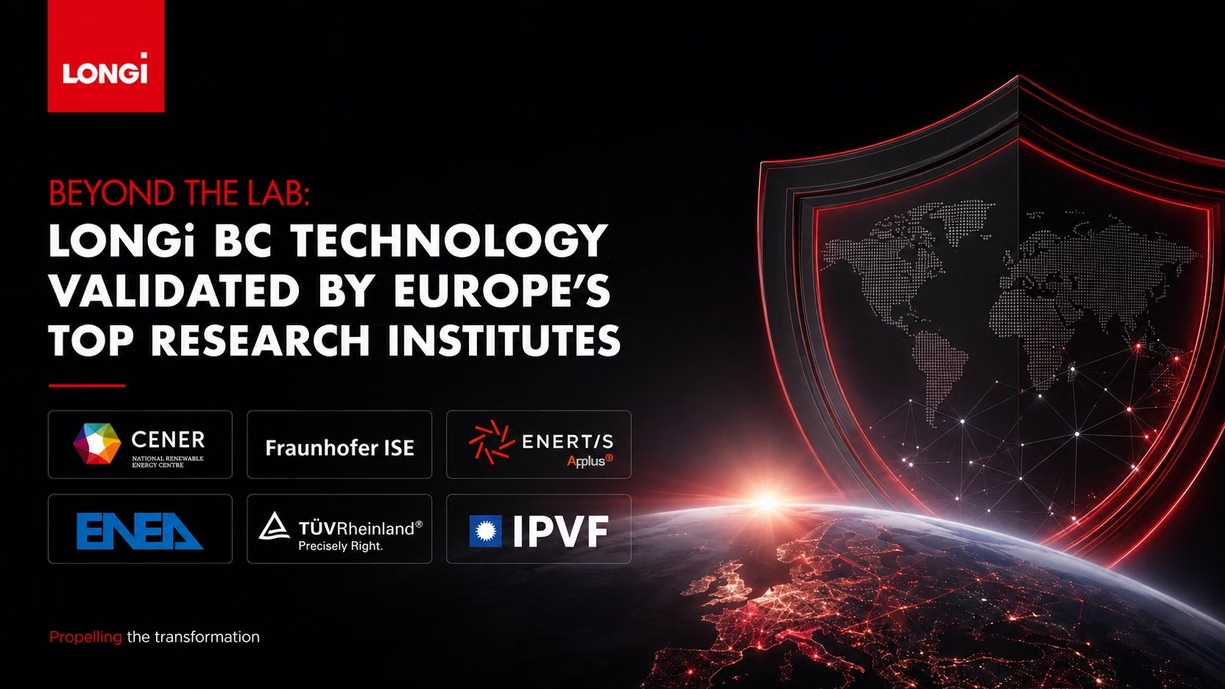
As PV markets mature, module value is increasingly measured by long-term energy yield and LCOE rather than nameplate power alone. Testing and analysis by CENER, ENEA, Enertis Applus+, IPVF and TÜV Rheinland have evaluated LONGi back contact technology under outdoor, rooftop and utility-scale conditions across Europe. The assessments cover shading and thermal performance, energy yield, and project economics, consistently finding advantages over the TOPCon technologies included in the respective comparisons. Together, the results provide evidence across different applications and markets of how BC module performance translates into energy generation and LCOE, while remaining specific to the tested conditions.
CENER testing finds over 30% higher BC power output under single-cell shading
Outdoor testing at the Spanish National Renewable Energy Centre (CENER) recreated a single cell fully shaded by a leaf. Under high irradiance, LONGi BC modules delivered more than 30% higher instantaneous power than TOPCon. Thermal imaging showed slower temperature rise and lower power loss in shaded areas of LONGi BC modules. “These results support the long-term value of BC modules in shaded scenarios,” said Jaime Moracho, Measurement and Testing Manager at CENER. CENER operates ENAC-accredited PV testing laboratories and has more than two decades of experience in PV module characterisation, supporting the technical basis of these outdoor findings.
ENEA rooftop testing finds 4.17% higher first-year energy yield for back contact
Rooftop testing under dynamic shading conditions at the Italian National Agency for New Technologies, Energy and Sustainable Economic Development (ENEA) compared BC and TOPCon modules. LONGi BC modules delivered equal or higher daily specific production on all measured dates in December and were estimated to achieve 4.17% higher first-year energy yield within the same installation area. Over a 30-year lifetime, the same-area energy yield is projected to reach 465,281 MWh for LONGi BC modules, compared with 442,439 MWh for TOPCon. ENEA’s PV testing activities are accredited by ACCREDIA and cover PV module qualification under CEI EN 61215 and CEI EN 61646.
Enertis Applus+ analysis finds up to 3.4% higher first-year energy yield for LONGi Hi-MO 9 back contact module
Analysis and simulation of utility-scale PV projects in Spain by Enertis Applus+, covering a 47 MW single-axis tracker project in Seville, showed that LONGi Hi-MO 9 back contact modules achieved higher first-year equivalent power generation hours than the TOPCon modules included in the assessment. Hi-MO 9 was estimated to achieve 2,209 equivalent full-load hours in the first year, corresponding to 2.4% to 3.4% higher energy yield per watt than the TOPCon alternatives. Enertis Applus+ holds an in-house PV testing laboratory internationally accredited to ISO/IEC 17025 by ENAC and has developed a patented mobile laboratory for on-site module testing, supporting the technical basis of this energy-yield assessment.
IPVF study finds lower LCOE for Hi-MO 9 across four European locations
An LCOE study by the Photovoltaic Institute of Île-de-France (IPVF) compared LONGi Hi-MO 9 with TOPCon modules for ground-mounted PV projects across four locations in France and Denmark. Hi-MO 9 recorded the lowest LCOE at all four locations, with reductions of approximately 3.2% to 3.6% compared with TOPCon 210R and 2.3% to 2.5% compared with TOPCon 199. The analysis assumed a module price premium of USD 0.01/W for Hi-MO 9. IPVF is a French photovoltaic research institute operating testing facilities and an R&D platform that support the transfer of PV technologies towards industrial validation.
TÜV Rheinland evaluation finds up to 4.1% higher first-year generation and up to 3.2% lower LCOE for Hi-MO 9 back contact module
System-level evaluations by TÜV Rheinland in Southampton, UK and Skalstrup, Denmark found that the LONGi Hi-MO 9 back contact module was estimated to achieve up to 4.1% higher first-year power generation and approximately 1.9% to 3.2% lower LCOE than TOPCon 210R under equal DC capacity and equal land area design conditions.
The review compared the BC module, in this case LONGi Hi-MO 9, with TOPCon 210R. For first-year power generation, TOPCon 210R was estimated at 19,781 MWh, while Hi-MO 9 was estimated at 20,046 MWh under equal DC capacity and 20,597 MWh under equal land area. For LCOE, TOPCon 210R was estimated at 5.3 cents/kWh in the first evaluation scenario and 3.43 cents/kWh in the second, while Hi-MO 9 was estimated at 5.13 to 5.2 cents/kWh and 3.32 to 3.33 cents/kWh respectively, corresponding to LCOE reductions of approximately 1.9% to 3.2%. TÜV Rheinland has operated as an independent third party in PV testing and certification for more than 35 years, with its laboratories accredited to ISO/IEC 17025.
View the corresponding video here:

Lorem ipsum dolor sit amet, consectetur adipiscing elit. Suspendisse varius enim in eros elementum tristique. Duis cursus, mi quis viverra ornare, eros dolor interdum nulla, ut commodo diam libero vitae erat. Aenean faucibus nibh et justo cursus id rutrum lorem imperdiet. Nunc ut sem vitae risus tristique posuere.