Subscribe to the LONGi Newsletter

Independent assessments from six respected European research, testing and certification organisations provide evidence of how LONGi’s back contact technology performs beyond standard laboratory conditions.
The photovoltaic market is changing. As solar deployment has expanded and module prices have fallen, the discussion around module value is increasingly moving beyond nameplate power and price per watt. For project owners, investors and installers, long-term energy yield, reliability, safety and the levelized cost of electricity (LCOE) are becoming increasingly important measures of technology value.
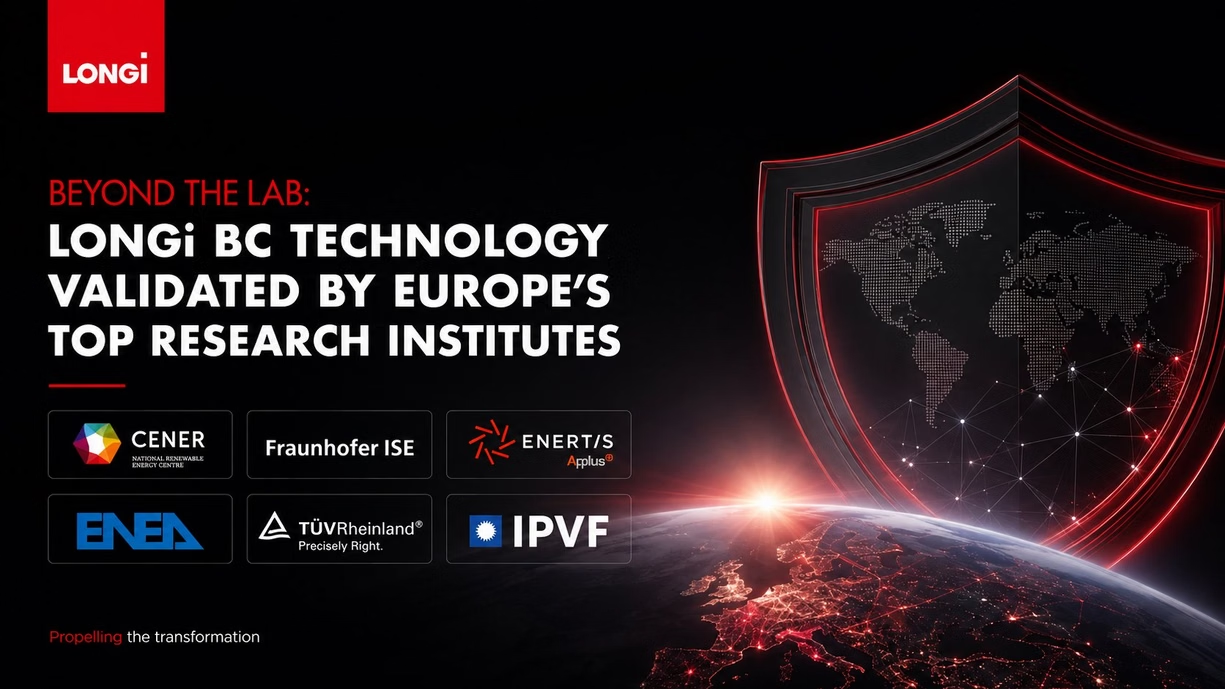
LONGi’s back contact (BC) technology has been assessed by six established European organisations: CENER, Fraunhofer ISE, Enertis Applus+, ENEA, TÜV Rheinland and IPVF. Together, their expertise spans photovoltaic research, module characterization, reliability testing, certification, field performance and energy-yield assessment.
Six independent European perspectives on BC performance
CENER, Spain’s National Renewable Energy Centre, operates accredited laboratories for photovoltaic components and solar cells. Its capabilities cover module performance, safety and reliability testing, outdoor testing and advanced characterization, including testing according to standards such as IEC 61215 and IEC 61730.
Fraunhofer Institute for Solar Energy Systems ISE in Germany operates an accredited PV Module TestLab covering power characterization, electrical safety and durability. Testing capabilities include outdoor exposure, thermal cycling and damp-heat testing, providing independent assessment of module behaviour under environmental and operational stress.
Enertis Applus+ combines accredited PV testing with engineering, field performance analysis and energy-yield assessment. In Spain, an Enertis Applus+ assessment of a 47 MW single-axis tracker project in Seville found that LONGi’s Hi-MO 9, based on HPBC 2.0 technology, achieved 2.4% to 3.4% higher watt-for-watt energy yield than the TOPCon modules evaluated at the same site. The analysis also calculated LCOE reductions of 3.92% and 4.47%, respectively.
ENEA, the Italian National Agency for New Technologies, Energy and Sustainable Economic Development, conducts photovoltaic research and experimental work spanning cell and module characterization, performance and operating behaviour. Its work provides a research perspective on how advanced PV technologies perform beyond nominal module specifications.
TÜV Rheinland provides independent testing and certification across several performance characteristics of LONGi’s BC portfolio. The Hi-MO X10 series, based on HPBC 2.0, received TÜV Rheinland Class A certification for shadow resistance. Partial shading caused by trees, buildings, equipment or other obstructions can reduce power generation and contribute to localized overheating. LONGi’s bypass structure is designed to allow current to bypass shaded areas, supporting power generation while reducing hot-spot risk.
TÜV Rheinland testing has also assessed the optical performance of the Hi-MO X10 Guardian Anti-Glare. The module achieved a maximum daylight glare probability (DGP) of 0.29, corresponding to an AAA classification according to EN 17037 under the applied assessment methodology. The technology is designed for applications where reflected light has to be controlled, including airports and transport infrastructure.
The wider Hi-MO X10 Guardian family demonstrates how BC technology can be adapted to specific project conditions. Hi-MO X10 Guardian Light Design, for example, has a module weight of approximately 7.2 kg/m². It is around 32% lighter than conventional single-glass modules, according to LONGi, opening additional possibilities for commercial and industrial roofs with structural load limitations.
IPVF, the Photovoltaic Institute of Île-de-France in France, combines photovoltaic research with characterization, reliability and modelling. Its assessment of two 50 MW ground-mounted PV projects in France and Denmark found that Hi-MO 9 generated an average 1.84% more energy per watt than the TOPCon modules evaluated. IPVF's calculations also showed LCOE reductions of 3.32% and 2.43% compared with the two TOPCon module types assessed.
LONGi BC modules are increasingly designed around operating, real world conditions
The independent assessments come as LONGi is broadening the role of BC technology itself. The focus is not only on increasing module efficiency, but on developing modules around the specific conditions in which solar installations have to operate.
As solar expands into more locations, project conditions are becoming increasingly diverse. Extreme weather, hail, coastal corrosion, dust, partial shading, glare, fire safety and structural roof limitations can affect energy yield, reliability and, in some cases, whether a PV project can be realised at all.
LONGi’s response is a growing portfolio of application-specific BC modules. For commercial and industrial applications, the Hi-MO X10 Guardian portfolio includes Anti-Glare for glare-sensitive locations such as airports and transport infrastructure, Light Design for roofs with structural load limitations, and a Fire-Resistant solution for sites where fire safety is a particular consideration.
The same approach extends to utility-scale solar. The Hi-MO 9 application-specific portfolio includes HydroClear, designed to address dust accumulation and maintenance; Sea-Shield, engineered for coastal, offshore and high-salinity environments; and Ice-Shield, developed for sites exposed to severe hail. Ice-Shield, for example, has been tested against hailstones up to 55 mm in diameter at 33.9 m/s at a 30-degree inclination.
Together, these developments point to a broader shift in module design: specific module characteristics are increasingly being engineered around the conditions of the installation. Across rooftops, ground-mounted projects and coastal and offshore environments, this allows module selection to respond more closely to the risks and performance factors that determine long-term project value.
Independent validation consequently has a wider role as well. Customers need evidence not only that a module reaches a certain efficiency under standard test conditions, but that the technology can deliver reliable energy yield, safety and long-term value under the conditions for which it was designed.
For project owners, investors and installers, this provides a broader basis for technology selection. As PV applications diversify, module value will increasingly depend on the combination of efficiency, long-term energy generation and performance under specific operating conditions. Independent evidence helps make those characteristics measurable and comparable.
Watch our video here:

Lorem ipsum dolor sit amet, consectetur adipiscing elit. Suspendisse varius enim in eros elementum tristique. Duis cursus, mi quis viverra ornare, eros dolor interdum nulla, ut commodo diam libero vitae erat. Aenean faucibus nibh et justo cursus id rutrum lorem imperdiet. Nunc ut sem vitae risus tristique posuere.