Subscribe to the LONGi Newsletter

Electricity demand in Poland is expected to grow by 89% between 2026 and 2050, according to Aurora Energy Research, an independent energy market analytics and consulting company. Among the European markets Aurora covers, only Portugal and Denmark are expected to see a larger increase. Heating, transport and industry are all moving to electricity, and much of this growth will take place on the sites of Polish businesses.
At the same time, the electricity that solar installations produce at midday is losing value. Aurora expects Polish solar to earn around 30% less than the average wholesale price by 2030, with the gap widening further by 2050.
For Polish companies that installed rooftop or on-site PV the economics are changing from both sides. Their consumption is growing, often in hours when solar output is low, while the surplus they do not use themselves earns less. The value of a PV system will depend less on its size and more on how much of its output the company uses itself.
Poland’s growing business power demand is increasing the need for storage
Many companies will feel Poland's demand growth on their own sites first. Production moves to a second shift, cooling and refrigeration run around the clock, and processes that used gas or other fuels switch to electricity. Heat pumps add further demand, mostly in the colder months.
Much of this new consumption does not follow the solar curve. It continues into the late afternoon and evening, when solar output falls. When several large loads start at once, for example when compressors and production lines start up together, they also create short demand peaks that a PV system cannot cover on its own.
Aurora expects growing demand and more decentralised generation to increase the need for flexibility across the Polish power system, meaning the ability to shift electricity between hours and to manage peaks. It sees batteries as one of the main ways to provide it.
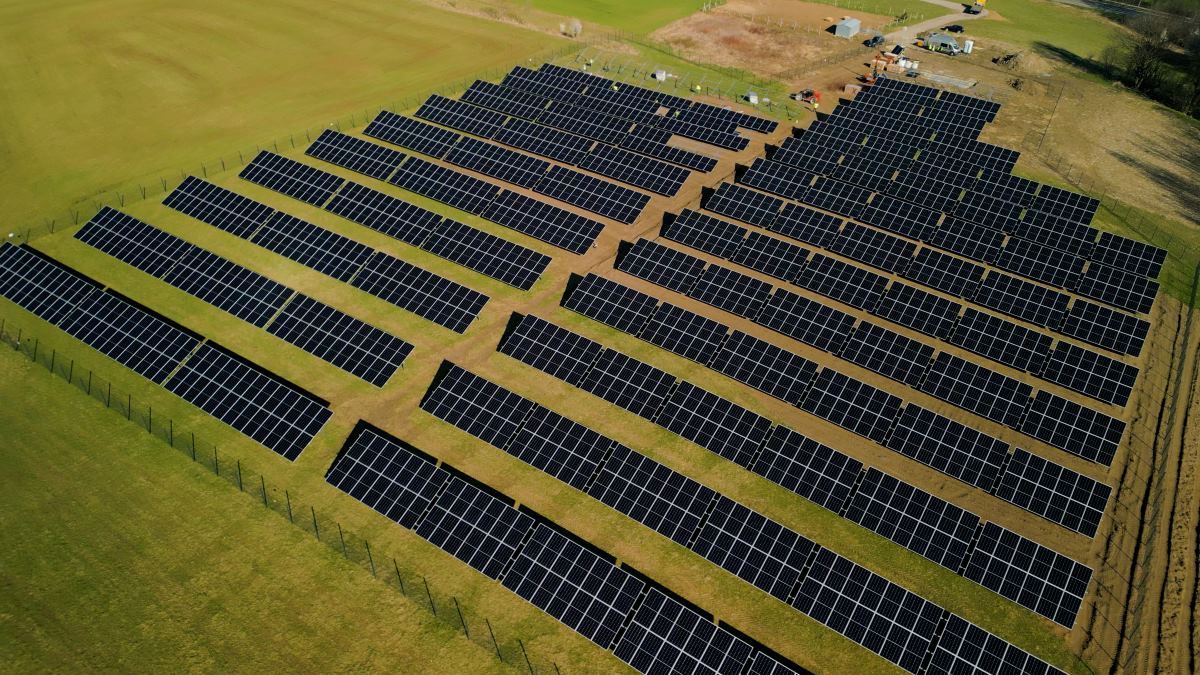
Polish businesses earn less from solar exported at midday
For Polish businesses, this development directly affects the value of surplus solar generation. Aurora expects the gap between solar capture prices and average wholesale prices to widen further as more solar enters the Polish market. Electricity fed into the grid is valued at market prices, whether it is sold directly or settled under net-billing. And companies whose electricity contracts or tariffs follow wholesale prices pay the most in the hours when their own PV produces little or nothing.
The result is a growing gap between the value of exporting surplus solar electricity at midday and using that electricity later on site.
Large batteries will serve the grid, not individual companies
Poland is preparing for a major expansion of large-scale battery storage. More than 11 GW of battery capacity has secured contracts in the capacity market, which pays power plants and batteries to be available when the system needs them, as Aurora Energy Research reports. The contracts cover delivery between 2027 and 2030, with combined terms of up to 19 years. Today, only about 0.2 GW of large-scale batteries are operating, and Aurora expects around 7 GW to be built by 2030.
These batteries are designed for the power system as a whole. They earn mainly from capacity payments, grid services and wholesale trading, and most of them are built as standalone projects rather than next to solar plants. They will add flexibility to the Polish power system, but they do not directly help an individual business use more of its own solar electricity or shift it to hours when grid electricity is more expensive.
On-site storage gives businesses more control over their own power
For an individual business, on-site storage serves a different purpose from the large batteries supporting the Polish power system. A battery installed alongside the company’s PV system gives the business more control over when it uses the electricity it generates. The battery can also reduce short demand peaks, for example when several machines start at the same time and provide backup power for critical equipment during a grid interruption. Because it is installed on the same site as the PV system, it can also use the business’s existing grid connection
The benefit is greatest from spring to autumn, when a solar system regularly produces more than the site uses during the day. In winter, when solar output is lower, peak reduction and backup power can remain relevant uses for the battery.
LONGi ONE brings solar and storage together for Polish businesses
LONGi's offer for commercial and industrial users is built on LONGi ONE, the company's integrated approach to solar and battery storage. The storage systems in the LONGi ONE portfolio are now available in Poland.
"Many Polish companies have already invested in their own solar systems. The question we now hear from them, and from our installation partners, is how to use more of that electricity on site, especially later in the day. With LONGi ONE, installers can offer a battery that works with the customer's PV as one system, from one supplier," said Adrian Kočan, General Manager Eastern Europe at LONGi Solar (Distributed Generation).
For factories, warehouses and other commercial sites, Hi-MO One MONA (125 kW / 261 kWh) stores surplus PV electricity for use in the afternoon and evening, with each cell monitored by LONGi's Intelligent Cell Control System (iCCS). OneNexus H2 is designed for sites where continuity of supply matters most. It combines PV, batteries, grid and generator supply in one energy management system and can switch to off-grid operation in 10 ms. Hi-MO One Pro suits businesses that expect their storage needs to grow, as capacity can be extended with additional cabinets.
The next opportunity for Polish businesses is to use more of their own solar
Poland is investing heavily in flexibility at power-system level. Businesses can create flexibility on their own sites by storing solar electricity when it is available and using it when they need it.
For companies that have already invested in PV, the next opportunity is therefore not necessarily to produce more electricity, but to use more of what they already produce. On-site storage gives them a way to do that.
Installers and businesses in Poland that want to assess storage for an existing PV system can contact LONGi Solar's team in Poland.
Source: Aurora Energy Research, RES and BESS market outlook for SEE and CEE, September 2026.

Lorem ipsum dolor sit amet, consectetur adipiscing elit. Suspendisse varius enim in eros elementum tristique. Duis cursus, mi quis viverra ornare, eros dolor interdum nulla, ut commodo diam libero vitae erat. Aenean faucibus nibh et justo cursus id rutrum lorem imperdiet. Nunc ut sem vitae risus tristique posuere.