Contact info
Nadine Bütow
Head of Corporate Communications, LONGi Distributed Generation Europe
nadinebuetow@longi.comSubscribe to the LONGi Newsletter

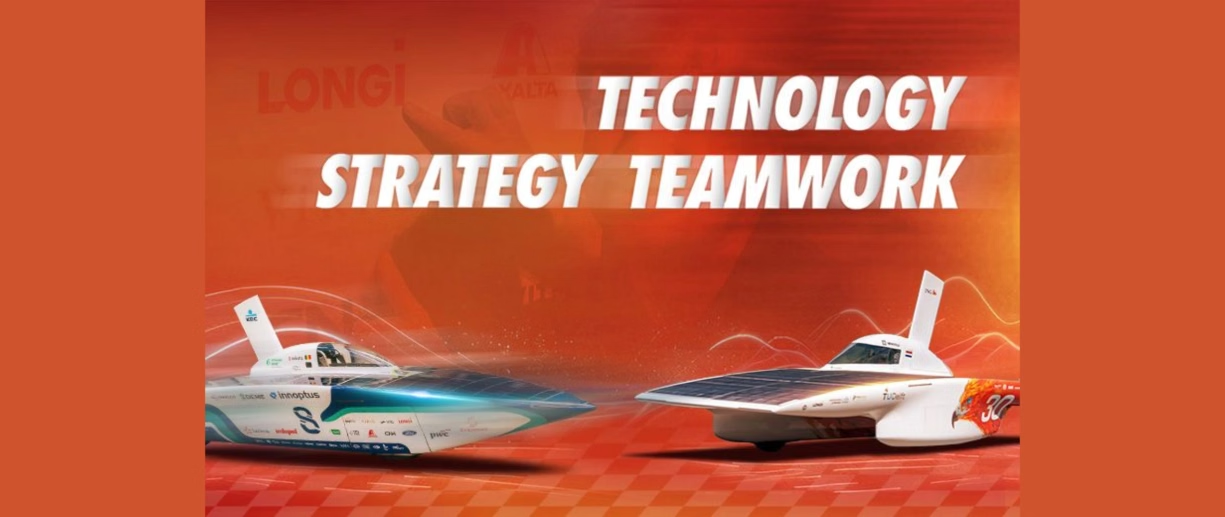
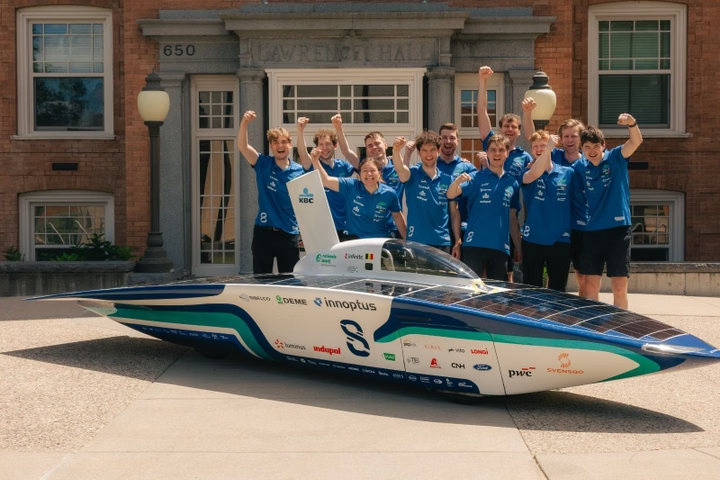
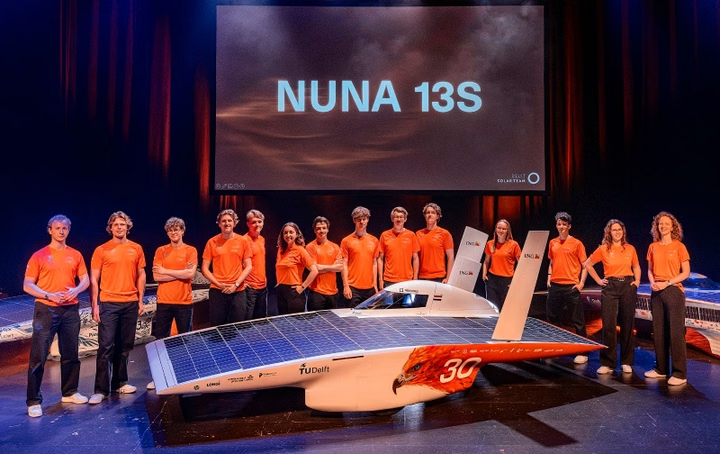
LONGi is supplying back contact (BC) photovoltaic technology to Belgium's Innoptus Solar Team and the Netherlands' Delft Solar Team for the 2026 Elektrek American Solar Challenge, which runs from 25 July to 1 August. The two teams are the only European entries in this year's field, and both finished in the top three at the 2025 Bridgestone World Solar Challenge. Each car carries a different LONGi solution, matched to how the cells sit on the vehicle and feed its energy system. The event gives LONGi eight days of BC cell performance under real operating conditions.
The race rewards cumulative distance over eight days rather than outright speed
The American Solar Challenge takes competitors from Minnesota to Texas, with much of the route following the historic Route 66 corridor. Teams are scored on the greatest cumulative distance covered across the eight days, not on how quickly they complete a stage. Cars pass through several climate zones and varied terrain along the way, so each team keeps adjusting how it spends the energy its array has collected. The competition is an endurance format for solar-powered vehicles, and the demands it places on a photovoltaic system are set by that format rather than by peak output on any one day.
The 2026 season adds a second team to a collaboration that began at the 2025 Bridgestone World Solar Challenge
LONGi worked with Innoptus Solar Team at the 2025 Bridgestone World Solar Challenge (BWSC), where the Belgian team finished in the top three. Delft Solar Team, also a top-three finisher at that event, joins for the 2026 American Solar Challenge. Both teams come from the global solar racing community that LONGi has been building technical relationships in since the 2025 season, and both are competing in North America this year as the only European entries on the start line.
Limited surface area on a race car makes conversion efficiency the binding constraint
A solar race car carries a small and fixed area of photovoltaic surface, and that array is the vehicle's only direct energy source. How much of the available sunlight the cells convert therefore sets the power available for everything else the car does. The cells also have to hold their output while the vehicle is moving, on curved bodywork and through the temperature variations of a long-distance run.
Innoptus Solar Team is equipped with LONGi's customised high-efficiency BC flexible modules, designed for the curved surfaces and the lightweight architecture of a solar race car. Delft Solar Team integrates LONGi's high-efficiency BC solar cell strings into its vehicle's energy system. High conversion efficiency and low array weight are what leave the teams room to work on aerodynamics and vehicle control, where the rest of the performance has to be found.
Energy management and route decisions set how far the collected power goes
Advanced photovoltaics on their own do not carry a car to the front of the American Solar Challenge. Teams read changing sunlight conditions and terrain across the eight days and adjust their energy use and route strategy against what they see. Each of those decisions affects the range the vehicle reaches before the day closes. Drivers and engineers work alongside the technology partners supplying the hardware, and the distance a car posts reflects that combination rather than any single component of it.
The race works as a validation environment for BC technology rather than a sponsorship
LONGi describes its work with both teams as technical collaboration and co-creation rather than sponsorship alone. The company treats solar motorsport as a platform where photovoltaic technologies are validated and refined under real operating conditions. Eight days of continuous running from Minnesota to Texas produces performance data on BC cells that a fixed installation does not generate, and LONGi uses what the two teams report in developing future solar applications.

Lorem ipsum dolor sit amet, consectetur adipiscing elit. Suspendisse varius enim in eros elementum tristique. Duis cursus, mi quis viverra ornare, eros dolor interdum nulla, ut commodo diam libero vitae erat. Aenean faucibus nibh et justo cursus id rutrum lorem imperdiet. Nunc ut sem vitae risus tristique posuere.