Subscribe to the LONGi Newsletter

On the Greek island of Tinos, repeated power cuts during the 2025 summer season became serious enough for the municipality to take legal action against the distribution network operator. Municipal records showed as many as 100 interruptions a day. Because the island relies on electrically powered desalination, the outages also affected water supplies, while hotels, restaurants and other businesses faced interruptions during the peak tourism season.
The episode illustrates a particular challenge for Greece. Parts of the country still depend on small autonomous electricity systems, while seasonal tourism can sharply increase demand. Solar and wind can provide more electricity locally, but their output varies. These systems therefore need ways to store renewable electricity and coordinate it with other available sources.
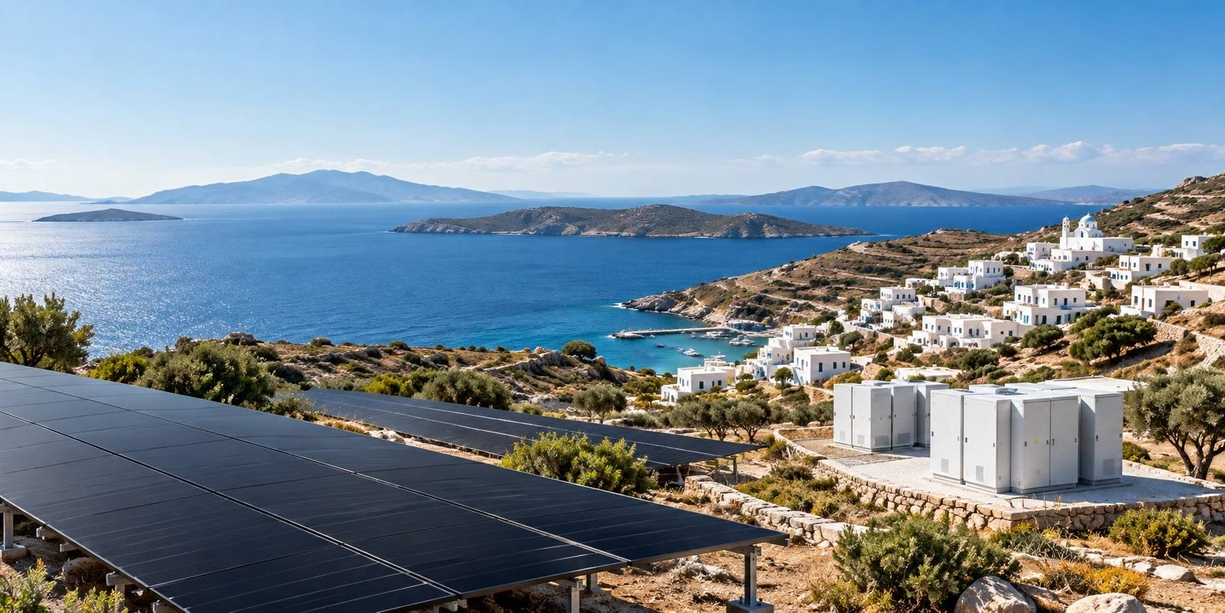
Microgrids provide one way of doing this. They combine and control electricity sources such as solar, batteries, the public grid and backup generators within a local system. That can help an island, business or infrastructure operator use more renewable electricity while maintaining power when renewable production falls or grid supply is constrained.
Greece still operates 28 non-interconnected power systems
Despite successive interconnection projects, Greece still has 28 Non-Interconnected Island power systems, according to the Hellenic Electricity Distribution Network Operator, HEDNO.
That means these islands or island groups cannot simply draw electricity from the mainland transmission system whenever they need it. Electricity has to be generated and balanced within the local system.
HEDNO's latest published overview lists around 933 MW of thermal generation capacity across the Non-Interconnected Islands, compared with around 160 MW of renewable capacity. HEDNO also lists two hybrid stations with combined capacity of just 2.95 MW (October 2024).
For an autonomous island, adding solar or wind capacity is therefore only part of the solution. A conventional power plant can adjust its output as demand changes. Solar production falls after sunset and varies with weather, while electricity demand continues throughout the day.
Storage can retain electricity when renewable production is high and release it later. Combined with an energy management system, it can also coordinate solar with the grid and other generation. This allows more renewable electricity to be used while keeping local supply and demand in balance.
Interconnections strengthen the grid but leave local constraints
Greece is also connecting more islands to the mainland through submarine cables. Once connected, an island can import electricity when local generation is insufficient rather than balancing all of its demand within an autonomous system.
Crete shows the effect. In December 2025, transmission system operator IPTO said the island's electricity demand was being supplied through its two mainland interconnections and local renewable generation without using its fossil-fuel power stations. IPTO estimates that the shift could save electricity consumers €400mn to €600mn a year over the following decade, largely through lower Public Service Obligation charges.
The Cyclades are following the same path. In July 2026, IPTO completed construction of the final phase of the Cyclades interconnection, bringing Santorini, Folegandros, Milos and Serifos into the mainland electricity system.
But connecting an island to the mainland does not mean every business suddenly has unlimited grid capacity or protection from a local power cut. Electricity still reaches individual sites through the local distribution network. A business can therefore be on an interconnected island and still have a connection that limits how much power it can draw, require backup during an outage or have surplus solar electricity that it cannot use immediately.
What a microgrid changes
A microgrid allows a site to manage several sources of electricity as one system. Solar can supply the site when the sun is shining, batteries can store excess electricity, the grid can provide additional power and a generator can remain available as backup.
The battery stores electricity; the microgrid determines how the site's different sources of electricity work together. If solar production exceeds demand, electricity can be stored for later. If demand rises above the power available from the grid, the battery can provide additional capacity. If the grid fails, a suitably configured microgrid can disconnect from it and continue supplying selected loads. At an off-grid site, the same system can coordinate solar, batteries and a generator without relying on the public network.
This gives microgrids a role beyond autonomous islands. Hotels, industrial facilities and other commercial sites can also face constrained grid connections, require continuity of supply or want to use more of the electricity generated by their own solar systems.
Greek islands provide an early blueprint for local energy systems
Greece already has practical examples of renewable generation, storage and local energy management operating together.
At Gaidouromantra on Kythnos, a long-running off-grid microgrid now supplies 14 holiday homes using 18 kW of solar PV, a 3.6 kW wind turbine, 90 kWh of battery storage and a backup diesel generator. Other projects on Kythnos have deployed storage at a school and desalination facility and tested PV-plus-storage systems where the grid cannot accept additional electricity exports.
Tilos operates a larger hybrid power station integrating wind, solar and 2.8 MWh of battery storage through an energy management system. According to the European Commission's Clean Energy for EU Islands initiative, the system can operate autonomously or in parallel with the grid and has generated €810,000 in fuel savings and avoided 5,000 tonnes of CO₂ emissions.
On Astypalea, PPC Renewables is developing a hybrid project combining 3.53 MW of solar capacity with 14.12 MWh of battery storage. PPC estimates annual generation of 6.55 GWh and says the project is designed to meet more than 80% of the island's electricity needs.
The projects differ in scale and architecture, but all show how storage and energy management can extend the use of variable renewable generation beyond the hours in which it is produced.
For EPCs and businesses, this shifts the design question beyond the size of the solar installation or battery. Grid capacity, backup generation, critical loads and the way these assets operate together determine how effectively a site can use the electricity available to it.
LONGi brings integrated microgrid storage to Greece
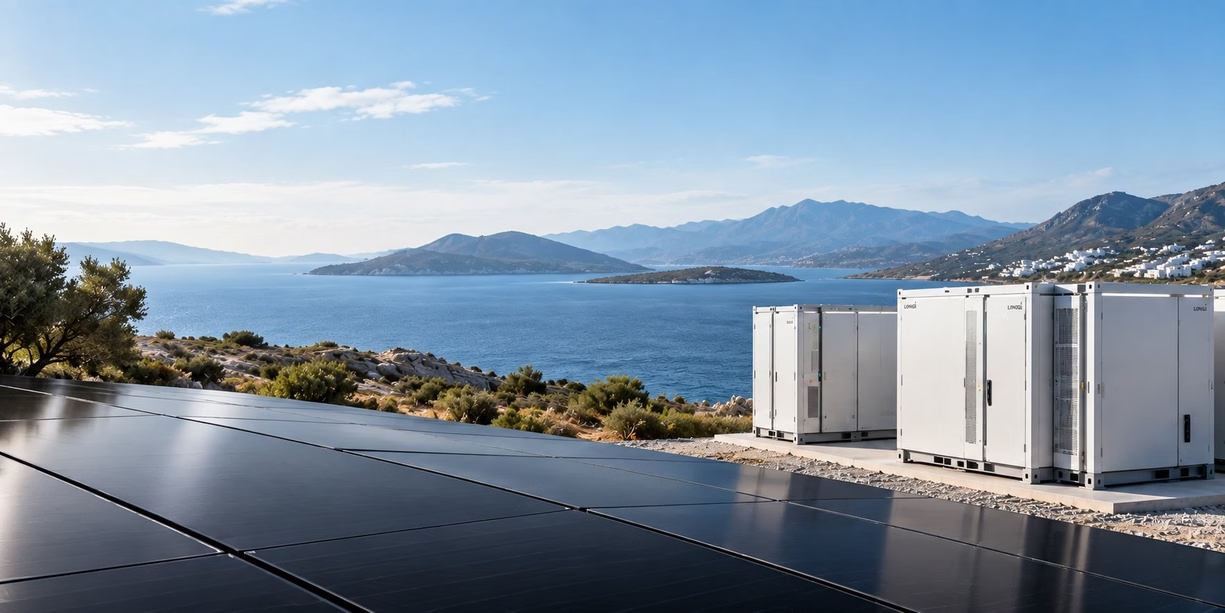
LONGi is addressing these applications with OneNexus H2, its integrated microgrid BESS for commercial and industrial applications. The system combines battery storage, hybrid power conversion, battery management, energy management, liquid cooling and fire protection within one architecture and can coordinate PV, storage, grid and generator supply.
OneNexus H2 is available in configurations from 50 kW / 104 kWh to 125 kW / 261 kWh. It supports 10 ms on/off-grid switching and black start, allowing critical loads to maintain near-continuous supply during grid interruptions and enabling a local system to restart without an external grid supply.
For sites with limited grid connection capacity, the system can use battery power alongside the available grid supply when demand exceeds the power that can be drawn from the connection. This allows additional load to be supported without relying solely on an increase in grid capacity.
At remote or off-grid sites, H2 can coordinate PV, battery storage and a generator. Solar can supply loads and charge the battery when production is available, while stored electricity covers demand when solar output falls. A generator can remain available when required, rather than operating continuously, reducing generator runtime and fuel consumption.
The same architecture can increase the amount of on-site solar generation that is used locally. Instead of exporting or losing surplus electricity when production exceeds consumption, the battery can store it for use later in the day. The energy management system controls the interaction between PV, battery, grid, generator and loads according to the site's operating conditions.
Up to six H2 units can be operated in parallel, allowing the system to serve larger commercial and industrial applications. Its modular configurations also allow power and storage capacity to be matched more closely to individual site requirements.
The relevance extends beyond Greece's autonomous islands. Hotels, commercial and industrial facilities, infrastructure operators and remote sites can face similar challenges around grid capacity, continuity of supply and the use of on-site solar generation.

Lorem ipsum dolor sit amet, consectetur adipiscing elit. Suspendisse varius enim in eros elementum tristique. Duis cursus, mi quis viverra ornare, eros dolor interdum nulla, ut commodo diam libero vitae erat. Aenean faucibus nibh et justo cursus id rutrum lorem imperdiet. Nunc ut sem vitae risus tristique posuere.