Subscribe to the LONGi Newsletter

Greece curtailed 1.60 TWh of renewable electricity in the first half of 2026, up from 1.33 TWh in the same period of 2025 and 514 GWh in 2024. Over the same six months, the number of hours with zero, near-zero or negative wholesale electricity prices rose to 788, from 168 a year earlier. Solar generators have felt the effect directly: their average capture rate fell to 44%, compared with 61.6% in the first half of 2025 and 71.9% two years earlier. In May, it dropped to just 28.3%.
The figures point to a growing imbalance in the Greek electricity system. Rapid renewable deployment is producing increasing volumes of electricity during periods when the system cannot fully absorb or economically value them. The consequences are visible in rising curtailment, depressed prices during periods of abundant generation and declining revenues for solar producers.
At the same time, Greece remains heavily dependent on fossil gas when renewable output is insufficient. The challenge is no longer generation capacity alone, but the flexibility to manage increasingly large swings in renewable supply over the course of the day.
Renewable growth is testing the electricity system
Renewables supplied 46.7% of Greece's domestic electricity demand in 2025, their highest share on record. Yet 1.87 TWh of renewable electricity was curtailed during the year, more than twice the 899 GWh recorded in 2024. As Greece adds photovoltaic capacity, more electricity enters the system during the same daylight hours. When supply exceeds what can be consumed, exported or accommodated by the network, renewable output has to be reduced.
Growing renewable oversupply is eroding the market value of solar
The effect is increasingly apparent in wholesale electricity prices. Greece recorded 135 hours with zero, near-zero or negative prices in the first half of 2024 and 168 in the same period of 2025. In the first half of 2026, that figure reached 788 hours.
For solar generators, the impact is reflected in the capture rate, which measures the value received for solar generation relative to the average wholesale electricity price. The average Greek solar capture rate fell from 71.9% in the first half of 2024 to 61.6% in the same period of 2025 and 44% in the first half of 2026. In May 2026, solar generation captured only 28.3% of the average wholesale price.
This is the effect often described as solar cannibalisation. As more PV capacity generates simultaneously, additional supply puts downward pressure on prices during the hours in which solar plants produce most.
The commercial implication is significant. In a market with growing volumes of solar generation, the value of electricity increasingly depends not only on how much is produced, but on when it reaches the market.
Greece’s renewable curtailment and record gas generation sharpen the case for storage
Greece curtailed 1.87 TWh of renewable electricity in 2025, while fossil gas generation reached a record 23.3 TWh, up 9.4% from 2024. The apparent contradiction is largely one of timing. Renewable oversupply is concentrated in particular hours, while gas-fired generation remains necessary when renewable output falls short of demand.
Greece's first large-scale batteries are beginning to address that mismatch. The first seven units entered trial operation in April 2026 with an estimated combined capacity of 220 MW. By July, batteries were absorbing electricity mainly between 08:00 and 15:00 and supplying it primarily between 16:00 and 23:00, according to IPTO scheduling data analysed by The Green Tank.
The analysis estimates that batteries prevented 13.6% of renewable curtailment in July and reduced gas use for electricity generation by 1.6%. While the installed fleet remains small, the early results show how storage can shift renewable electricity from periods of oversupply to hours when it is needed.
Price volatility is strengthening the commercial case
Price volatility is also strengthening the commercial case for storage. Frequent periods of very low or negative prices allow batteries to charge when electricity is abundant and discharge during higher-value hours. Analysis of the first three months of battery operation in Greece found that storage captured more than 70% of the available wholesale price spread.
Returns still depend on investment costs, battery duration and degradation, financing, grid connection and access to electricity and balancing markets. But widening price spreads are giving storage an economic function alongside its role in managing renewable oversupply.
Policy is preparing for storage at scale
Greek energy policy increasingly reflects the same shift. The country's National Energy and Climate Plan sets out a target of 4.3 GW of storage capacity by 2030, alongside further renewable deployment and investment in the electricity system.
The emerging pipeline could extend beyond that target. Aurora Energy Research, an independent energy market analytics and consulting company, estimates that announced initiatives could lift BESS capacity to around 6.8 GW by 2030 if they materialise. Its analysis includes subsidised projects, merchant storage and capacity expected through other licensing and support routes.
Greece has also opened a regulatory pathway for 4.7 GW of utility-scale standalone battery projects to receive priority grid connections and operate on a merchant basis without subsidy support. Greece has also opened a regulatory pathway for 4.7 GW of utility-scale standalone battery projects to receive priority grid connections and operate on a merchant basis without subsidy support. According to Aurora Energy Research, applications reached 12.15 GW by early 2026, almost three times the available capacity.
The scale of applications and announced initiatives should not be confused with projects under construction. Financing and regulatory questions remain, and only part of the pipeline is likely to proceed. But the response indicates the level of commercial interest in a market where the need for flexibility is becoming increasingly visible.
LONGi targets C&I and microgrid applications with expanded storage portfolio
Storage deployment is also moving closer to the point of consumption. Aurora Energy Research identifies 333 MW of BESS planned for commercial consumers alongside solar PV under Greece's “Storage Systems for Businesses” programme.
For businesses, storage provides a way to respond to these conditions by shifting solar generation into higher-value hours, managing demand peaks and, where required, reducing reliance on the grid.
Against this backdrop, LONGi is expanding its energy storage portfolio in Greece in September with Hi-MO One MONA and OneNexus H2. The two systems address different requirements, ranging from C&I energy optimisation with MONA to integrated microgrid management with H2.
The 125 kW / 261 kWh Hi-MO One MONA is engineered for C&I storage applications, combining liquid-cooled LFP storage with LONGi-developed power conversion, battery management, energy management and thermal management systems in an integrated architecture. Its Intelligent Cell Control System (iCCS) provides cell-level monitoring to identify developing abnormalities and enable predictive risk detection. For Greek businesses with rooftop or on-site solar, MONA can store surplus generation during solar-rich hours for use later in the day, increase PV self-consumption and reduce demand peaks. It can also support on-grid and off-grid operation where greater energy resilience is required.
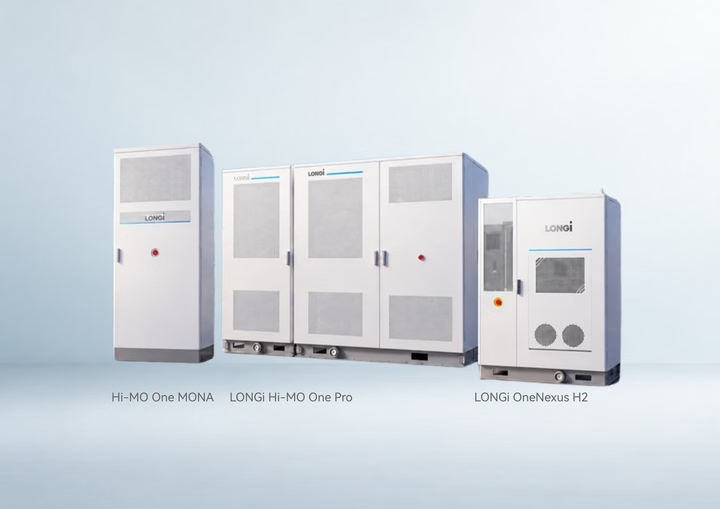
OneNexus H2 extends these capabilities to microgrid applications, integrating PV, battery storage, grid and generator supply within a single energy management architecture. Available from 50 kW / 104 kWh to 125 kW / 261 kWh, the system supports 10 ms on/off-grid switching and black start, supporting continuity for critical loads during grid interruptions and allowing the local energy system to restart independently of the grid. For Greek commercial and industrial sites with constrained grid capacity, OneNexus H2 can combine available grid capacity with solar and battery power, while remote or off-grid sites can coordinate PV, storage and backup generation to reduce generator runtime and fuel consumption.
Storage moves from renewable ambition to market requirement
Greece's renewable expansion has reshaped its electricity mix. It is now exposing the limits of a system that has added generation faster than the flexibility needed to accommodate it.
Renewable electricity is increasingly abundant during certain hours, while the power system has limited capacity to shift that supply to periods when it is needed or more valuable.
Batteries are only part of the response. Greece will also require investment in transmission and distribution networks, interconnections and demand-side flexibility. Storage, however, addresses a specific constraint - it can retain electricity that would otherwise be curtailed or sold during periods of depressed prices and return it to the system later.
The case for BESS in Greece is therefore increasingly being shaped by conditions already present in the market. The growth in solar and wind will depend not only on how much additional capacity Greece can build, but on how effectively its electricity system can use the power that capacity produces.

Lorem ipsum dolor sit amet, consectetur adipiscing elit. Suspendisse varius enim in eros elementum tristique. Duis cursus, mi quis viverra ornare, eros dolor interdum nulla, ut commodo diam libero vitae erat. Aenean faucibus nibh et justo cursus id rutrum lorem imperdiet. Nunc ut sem vitae risus tristique posuere.