Subscribe to the LONGi Newsletter

Energy access sounds like a topic for other continents. In 2024, 9.2 percent of the EU population could not keep their home adequately warm, according to Eurostat, with the share reaching 17.5 percent in Spain and 19.0 percent in Bulgaria and in Greece. Affordability is one version of the problem, and it sits inside the European market rather than outside it.
The second version is a grid that exists and stops working. Attacks on energy and transport networks in southern Ukraine left the Izmail district without electricity for three days at a stretch during 2025, and the district hospital lost the supply its ventilators and diagnostic equipment depend on. Both versions are answered at the level of one roof, which is where an energy access project starts.
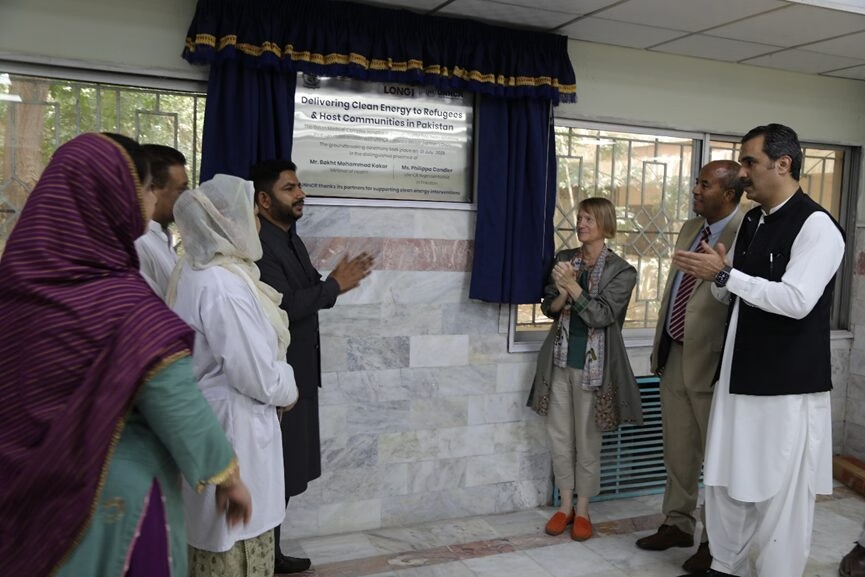
Energy access projects run through LONGi's European organisation, and each is recorded as capacity on a named building with a named partner behind it. A district hospital in Ukraine's Odesa region and a maternity clinic in rural Mozambique carry two of them. A third sits on a village school in the Spanish province of Huelva.
A hospital in Ukraine can still perform surgery when the grid fails
LONGi donated the back contact solar modules for a 30 kW solar and storage system at the Central District Hospital in the Izmail district, built by the Energy Act for Ukraine Foundation in coordination with the Verkhovna Rada Committee on Energy and Housing and Communal Services, and completed in October 2025. The battery is the reason it functions during an outage rather than only lowering a bill. The surgical and intensive care units keep working for several hours after a complete grid failure, and the system holds voltage steady through the fluctuations that sensitive diagnostic equipment cannot tolerate.
"During the latest outage, there was no electricity for three days," said Oleh Sadkovskyi, CEO of the Central District Hospital of the Safianivka village council, who added that generators could not run reliably over a period that long. The building has since taken on a second role, as residents come in to charge phones and to get warm while the power is out.
A clinic in Mozambique now delivers babies with running water on site
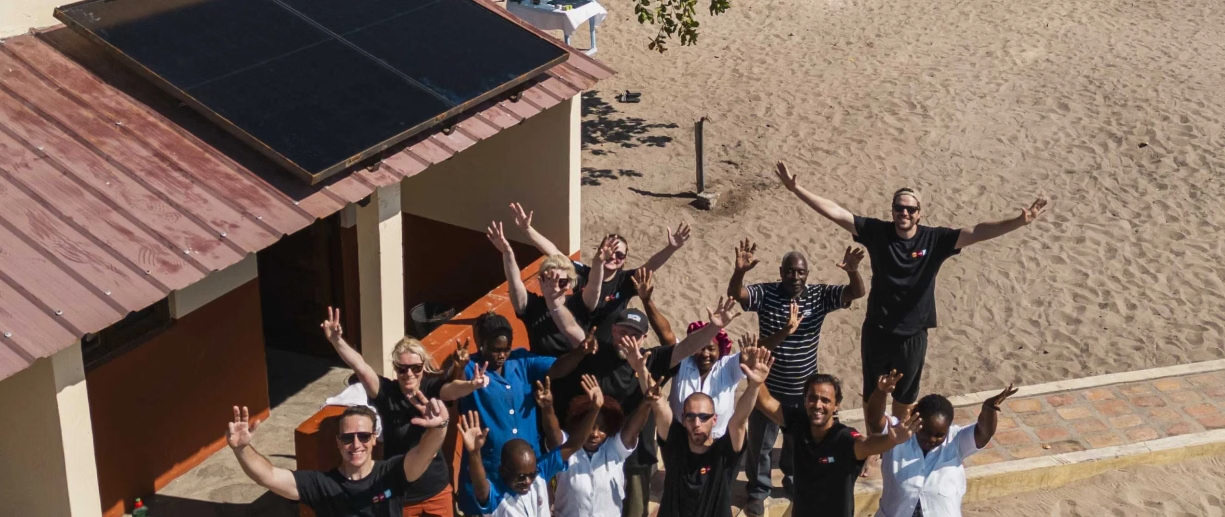
Linga Linga, a village in Mozambique's Inhambane province, had no electricity access for 99 percent of its population. Women gave birth at home or on the road to Morrumbene, the nearest facility, around 30 kilometres away. A maternity clinic was built there by the non-profit Project Vita, and the health clinic beside it had been shut for three years for want of energy.
LONGi Europe and the Swedish distributor Senergia donated a 0.86 kW rooftop system of back contact modules, which powers a pump that fills a water tower and puts running water into the clinic. The installation was completed in May 2024, and around 17 babies are delivered there each month. Michel Olofsson, who founded Project Vita, describes installations of this kind as ones that save lives. The clinic had everything else it needed before the pump had power.
In a Spanish village, the school roof now powers the houses around it
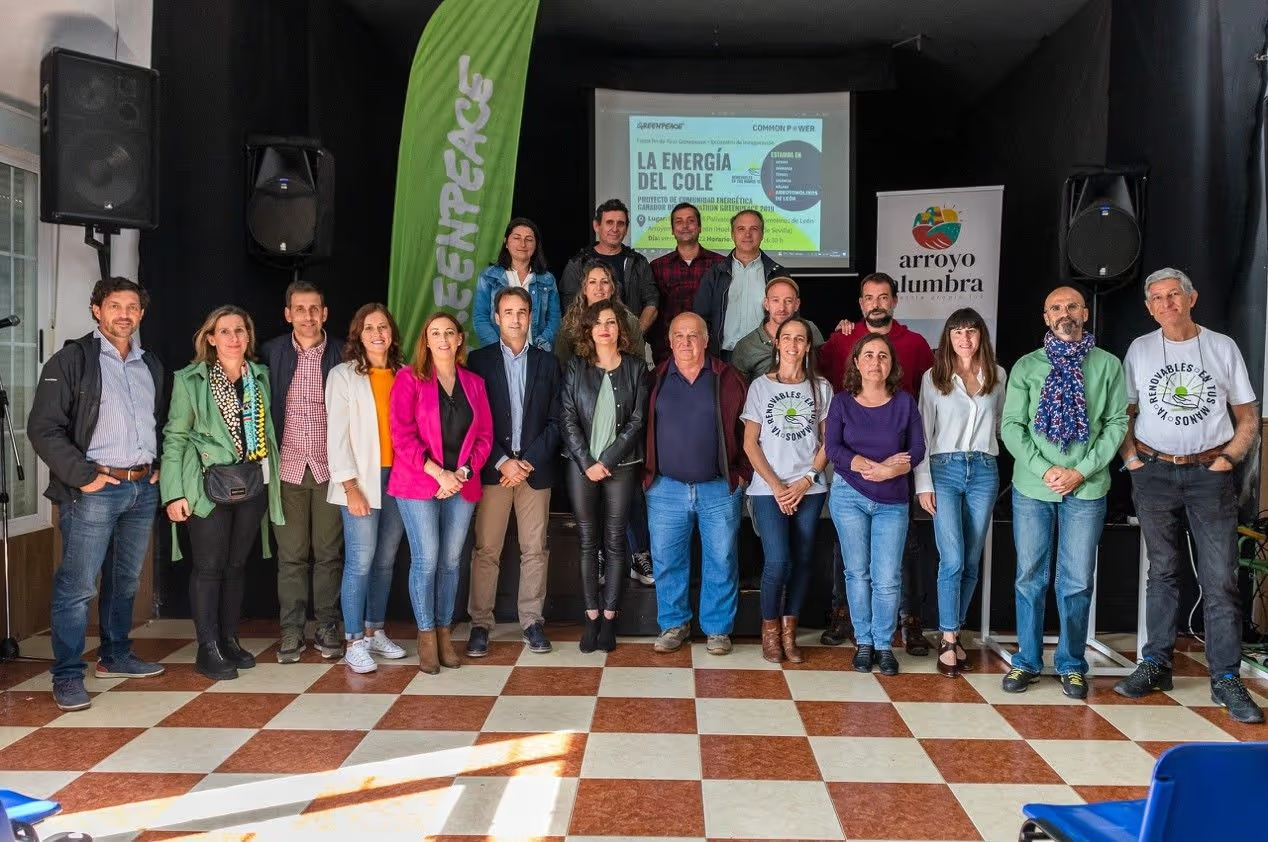
Arroyomolinos de León, a village in the province of Huelva, runs a 42.5 kWp installation on the roof of its school. The project began as the school's winning entry to Greenpeace Spain's Renovathon competition and was inaugurated in November 2022, with LONGi donating the modules. A share of the output is allocated to households in the village, which is what makes it an energy access project rather than a school retrofit.
The alliance behind the installation is mostly local. The municipality sits in it alongside Greenpeace, the cooperatives Aeioluz and MEGARA, the MUTI Association and the school's parents' association. Internationally the project was backed by POWERPOOR, an EU-funded programme working across 11 European countries on financing for energy communities. The electricity stays in the village that generates it.
What a social claim is worth depends on what is still running afterwards
None of these systems moves a national energy balance, and none was built to. What each changes is measurable at the address where it sits. A hospital keeps its theatre lit through an outage that used to stop it, and a clinic has running water at the moment a birth needs it. Each record names a place, a capacity, an operator and a partner who can be asked what happened next, which is the difference between a social impact figure and a social impact project. When a buyer or an auditor asks a supplier what its social contribution amounted to, the answer worth having is the one that is still generating.

Lorem ipsum dolor sit amet, consectetur adipiscing elit. Suspendisse varius enim in eros elementum tristique. Duis cursus, mi quis viverra ornare, eros dolor interdum nulla, ut commodo diam libero vitae erat. Aenean faucibus nibh et justo cursus id rutrum lorem imperdiet. Nunc ut sem vitae risus tristique posuere.