Subscribe to the LONGi Newsletter

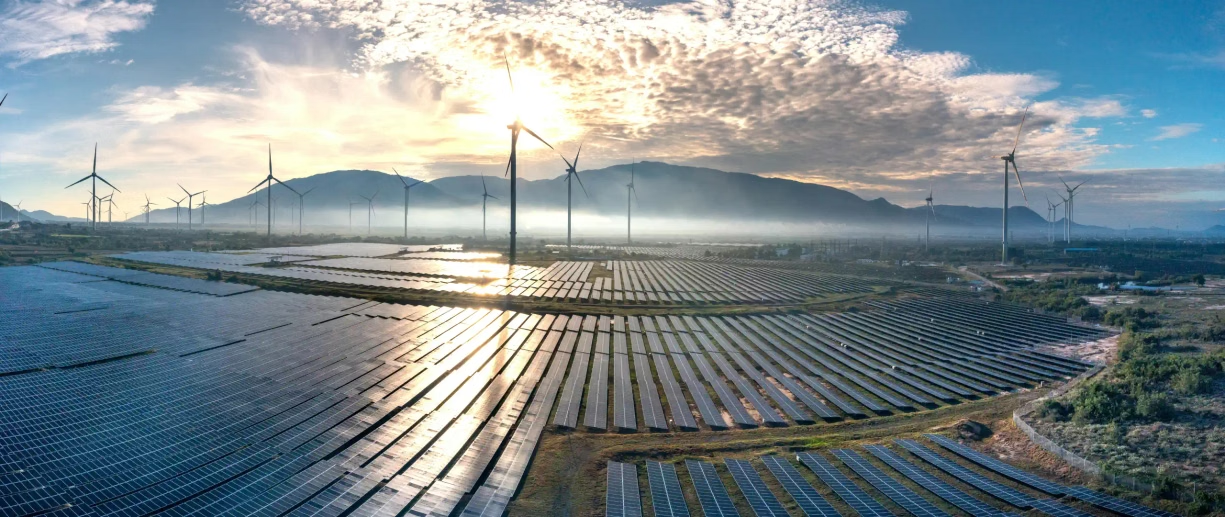
Grid capacity and system flexibility are becoming constraints on further renewable growth in Eastern Europe. Across the region, renewable capacity is expanding faster than the flexibility needed to integrate it. Grid operators are confronting limits on additional variable generation, governments are supporting large-scale battery deployment, and regulators are creating new rules for storage and flexibility. At the same time, growing solar penetration is increasing balancing needs, and resilience has become an additional consideration in parts of the region.
The response is taking different forms. In Slovakia, the transmission system operator applies a flexibility-based limit to additional solar and wind capacity. Poland has approved support for 172 large battery projects to strengthen grid stability. Bulgaria is backing at least 3 GWh of new storage. Moldova's transmission system operator estimates that the electricity system requires 246 MW of balancing capacity. Ukraine has commissioned 200 MW / 400 MWh of distributed battery storage as it works to strengthen the resilience of its electricity system.
For battery developers, EPCs and businesses, the common issue is increasingly clear. Renewable capacity can grow faster than the ability of the electricity system to absorb, shift and balance its output.
Grid flexibility is becoming a condition for further renewable growth
Slovakia provides one of the clearest examples. In June 2025, transmission system operator SEPS released another 170 MW for new or expanded solar and wind generation, increasing the limit applied from a system-flexibility perspective from 747 MW to 917 MW. The figure is not a limit on Slovakia's total renewable capacity. It determines how much additional variable generation can be connected under SEPS's flexibility assessment.
The distinction matters. Solar and wind output changes independently of electricity demand. As their share increases, the system needs more capacity capable of responding when generation rises or falls. Batteries can absorb electricity during periods of surplus generation and return it when the system requires additional supply.
Poland is addressing the same requirement at much greater scale. In December 2025, the government approved support for 172 battery projects with a combined 3.9 GW of power and 14.5 GWh of storage capacity. Two additional large-scale projects at Żarnowiec and Ełk will provide a combined 425 MW / 2,032 MWh. At Żarnowiec, a 263 MW / 900 MWh system is under construction, with completion scheduled for the second quarter of 2027. The project is designed to support renewable integration and the balancing of offshore wind generation.
Bulgaria is pursuing another large deployment programme. Its RESTORE scheme supports battery systems connected to transmission and distribution networks with at least 3,000 MWh of usable storage capacity.
Hungary shows another consequence of rapid solar growth. Solar accounted for 28% of electricity generation in 2025, according to the European Commission, which also identified grid congestion, connection queues and limited non-fossil flexibility as constraints on the electricity system. Battery deployment accelerated in 2025 and early 2026 as the country increased investment in storage and grid flexibility.
These markets are moving beyond the question of whether batteries are required. The focus is shifting towards how much storage is needed, where it should be connected and which system services it can provide.
Storage is becoming part of electricity market design in Eastern Europe
Czechia illustrates a different stage of development. Its LEX OZE III legislation formally integrated electricity storage, aggregation and flexibility into the electricity market. The government's National Action Plan for Flexibility, approved in June 2025, sets a framework through 2035 for increasing non-fossil flexibility through storage and demand response.
North Macedonia has taken a similar step. Its 2025 Energy Law established storage as a separate energy activity and created a legal basis for its participation in the electricity market.
These changes are important because installing a battery does not by itself create a functioning storage market. Batteries need rules governing connection, charging and discharging, aggregation and participation in electricity and balancing markets.
Moldova shows what happens when the requirement becomes quantifiable. In 2025, Moldova’s transmission system operator estimated that the electricity system requires 246 MW of balancing capacity, including 72 MW of automatic frequency restoration reserve and 174 MW of manual frequency restoration reserve. According to the government, 80 MW can be provided by existing infrastructure, leaving additional capacity to be developed. Moldova is also linking new renewable capacity directly with storage. In August 2026, seven projects totalling 170 MW were selected under the country's latest wind tender In August 2026, seven projects totalling 170 MW were selected under the country's latest wind tender, with battery storage mandatory for each project.
In Ukraine, resilience is an additional driver. Six battery facilities with a combined capacity of 200 MW / 400 MWh entered operation in September 2025, adding distributed storage to an electricity system where reliability and continuity of supply remain significant concerns.
Grid constraints are changing the case for C&I storage and microgrids
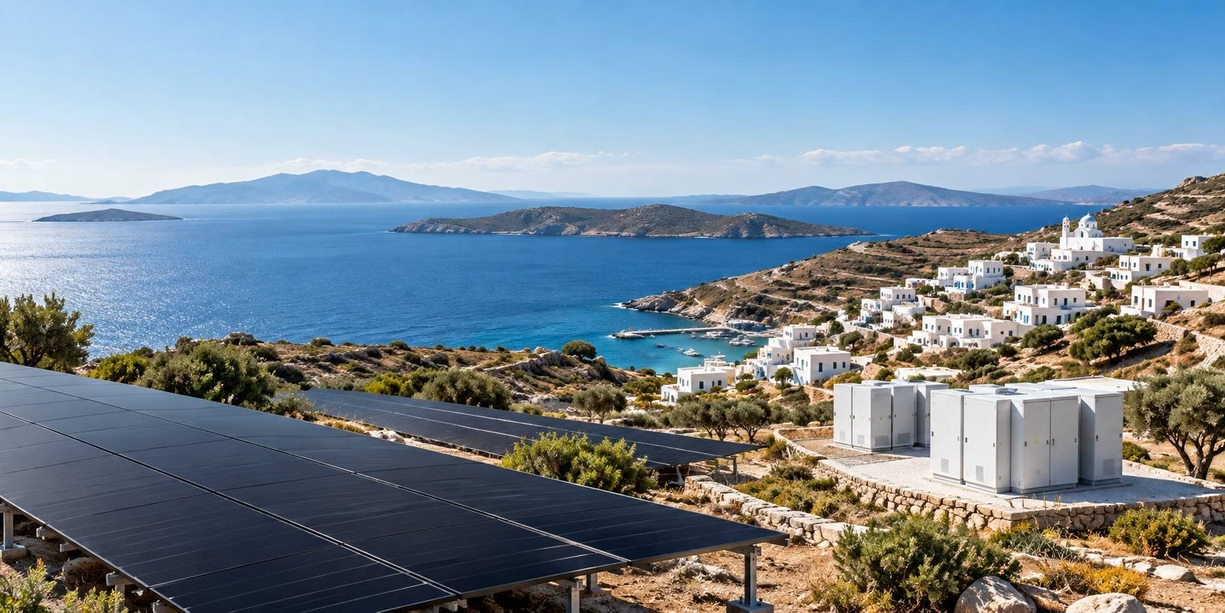
The regional storage build-out is not limited to transmission networks. Commercial and industrial sites are adding solar generation while facing their own constraints around grid capacity, demand peaks and continuity of supply. Electricity generated on a rooftop at midday does not necessarily coincide with the hours in which a business consumes most electricity. A site may also have insufficient grid capacity for new production equipment, charging infrastructure or other additional loads.
A C&I battery can shift solar generation into later hours, increase self-consumption and reduce demand peaks. Sites requiring longer storage duration need greater energy capacity without necessarily increasing power at the same rate.
A microgrid addresses a different problem. It manages how several sources of electricity work together. Solar, battery storage, the public grid and a generator can be coordinated within one local system. If grid capacity is insufficient, the battery can supplement the available connection. If the grid fails, a suitably configured system can continue supplying selected loads. At remote or off-grid sites, solar and storage can reduce the operating hours of backup generators. The battery stores electricity. The microgrid determines how the site's available sources of electricity are used.
LONGi expands BESS and microgrid portfolio in Eastern Europe
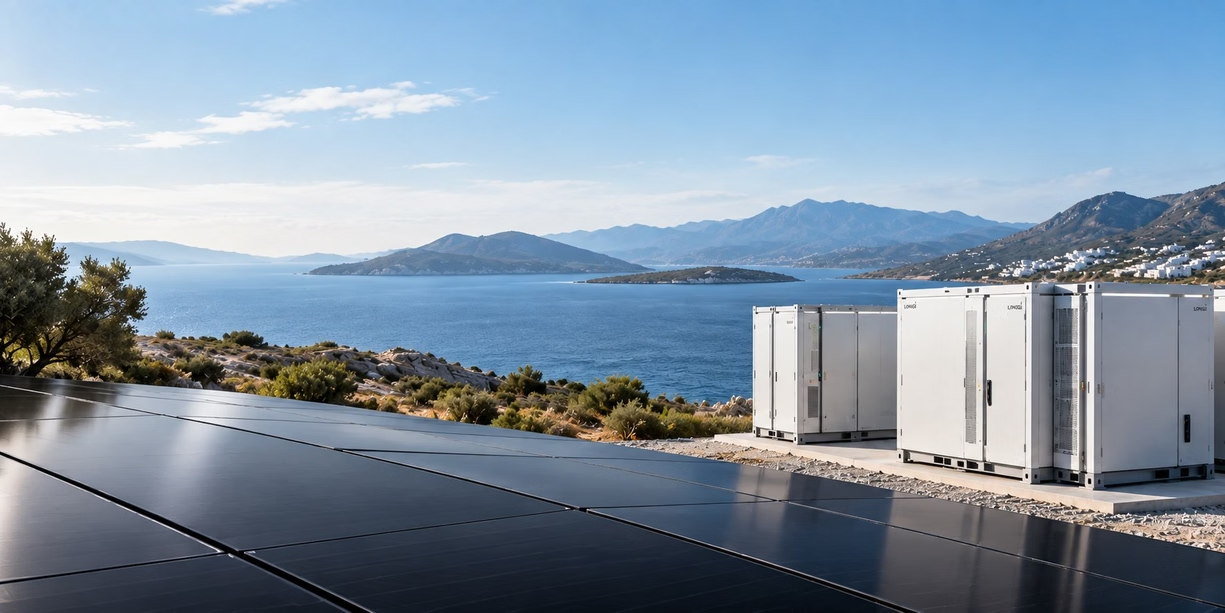
LONGi is addressing these different requirements with three storage architectures for commercial, industrial and distributed energy applications.
Hi-MO One MONA is engineered as a 125 kW / 261 kWh all-in-one C&I storage system. The unit integrates battery storage with LONGi-developed power conversion, battery management, energy management and thermal management. Typical applications include PV self-consumption, energy shifting and peak management. LONGi's Intelligent Cell Control System monitors individual cells to identify developing abnormalities and provide predictive risk detection.
Hi-MO One Pro separates power and energy capacity, allowing its 261 kWh battery cabinets to be configured independently of the AC power equipment. Storage capacity can therefore be increased without adding power-conversion capacity at the same rate. Configurations range from 2 to 24 hours of storage, allowing C&I sites to size the system according to both the required output power and the amount of electricity that needs to be stored.
OneNexus H2 combines battery storage with microgrid control in configurations from 50 kW / 104 kWh to 125 kW / 261 kWh. Its hybrid power conversion system coordinates PV, battery storage, grid supply and generators within one local energy system. OneNexus H2 supports on- and off-grid operation, 10 ms switching between the two modes and black start. It can also supplement a constrained grid connection with battery power when site demand exceeds the available grid capacity.

Lorem ipsum dolor sit amet, consectetur adipiscing elit. Suspendisse varius enim in eros elementum tristique. Duis cursus, mi quis viverra ornare, eros dolor interdum nulla, ut commodo diam libero vitae erat. Aenean faucibus nibh et justo cursus id rutrum lorem imperdiet. Nunc ut sem vitae risus tristique posuere.