Subscribe to the LONGi Newsletter

Regulatory bodies across Europe now mandate strict product carbon footprint evaluations for market access and tender approvals. In France, the PPE2 energy policy recently strengthened the compliance requirements for the carbon footprint of photovoltaic products. Consequently, energy developers must account for the entire environmental impact of solar installations from raw material extraction to end-of-life disposal.
Asset managers need full-chain visibility to calculate accurate carbon payback periods and meet corporate disclosure directives. A narrow focus on factory emissions ignores the massive impact of the broader supply chain. Procurement teams face project disqualification when they rely on incomplete lifecycle metrics.
Comprehensive solar lifecycle emission tracking ensures regulatory compliance and guarantees true carbon reductions in energy procurement, a standard LONGi demonstrably fulfills through systematic optimization across every stage from green manufacturing to end-of-life material recycling.
Upstream supply chain metrics expose the largest emission sources
Complete environmental assessments require precise data from all material inputs. Scope 3 indirect emissions account for 89.6% of the total value chain footprint for solar equipment. Within this category, purchased goods such as polysilicon and aluminum frames generate the vast majority of greenhouse gases. Developers build transparent sustainability reports when component manufacturers utilize low-carbon silicon and recycled aluminum. Accurate upstream data replaces generic industry estimates and protects project bankability.
Zero-carbon manufacturing facilities lower the embedded carbon intensity
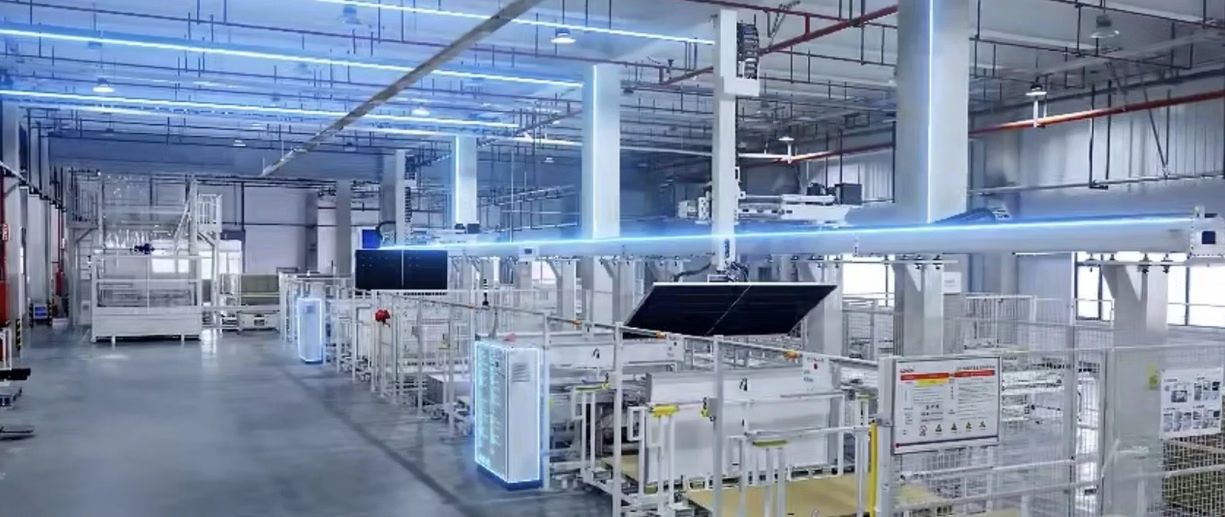
Factory operations play a critical role in the overall lifecycle impact of solar modules. Production facilities reduce direct emissions through energy efficiency upgrades and large-scale renewable electricity substitution. The Jiaxing production base recently secured the ISO 14068 carbon neutrality certification to establish an industry-first dual benchmark. Clean manufacturing practices translate directly into lower embedded carbon for the final product. Project planners secure a faster environmental return on investment when they source components from carbon-neutral facilities.
Extended product lifespans and material recycling close the ecological loop
Sustainable procurement requires robust end-of-life treatment plans to minimize long-term ecological damage. High-efficiency technologies and robust physical designs extend module service life to 30 years to improve the economic and environmental payback. At the end of the operational lifecycle, specialized recovery processes extract valuable resources from decommissioned hardware. Up to 94% of the materials in photovoltaic modules can undergo recycling and reuse. A strong circular economy framework prevents material waste and secures long-term regulatory compliance.
Comprehensive solar lifecycle emission tracking ensures regulatory compliance and guarantees true carbon reductions in energy procurement.

Lorem ipsum dolor sit amet, consectetur adipiscing elit. Suspendisse varius enim in eros elementum tristique. Duis cursus, mi quis viverra ornare, eros dolor interdum nulla, ut commodo diam libero vitae erat. Aenean faucibus nibh et justo cursus id rutrum lorem imperdiet. Nunc ut sem vitae risus tristique posuere.