Subscribe to the LONGi Newsletter

Solar energy plays a key role in reducing greenhouse gas emissions, but producing solar modules also requires energy and raw materials. Silicon processing, glass production, aluminium manufacturing and more all contribute to their carbon footprint. The growing share of solar energy worldwide and increasing pressure on companies to reduce their carbon footprint make the environmental impact of solar modules more important than ever.
Higher efficiency means that solar modules can generate more electricity from the same area. It also allows manufacturers to use less material to achieve a given power output. Both can help reduce the carbon footprint of solar electricity, although the energy and resources needed to manufacture the modules also matter.
Environmental Product Declarations reveal the carbon footprint of solar modules
Environmental Product Declarations (EPDs) provide independently verified information about a product's environmental impact. They assess emissions associated with raw materials, manufacturing, transport and end-of-life treatment. This allows the carbon footprint of solar modules to be evaluated using standardised methods.
According to LONGi's independently verified EPD, producing a 665 Wp back contact module causes about 214 kg of CO₂e emissions. The figure rises to 236 kg CO₂e when transport, end-of-life treatment and other lifecycle stages are included. Manufacturing and raw materials therefore account for roughly 90% of the module's total carbon footprint.
The EPD also shows where these emissions originate. Solar cell production accounts for 59.3% of product-stage greenhouse gas emissions, followed by glass at 15.8% and aluminium frames at 14.6%. The module weighs approximately 33.2 kg, with glass making up almost 81% of its weight. Solar cells, by comparison, weigh less than 0.8 kg but account for the largest share of manufacturing emissions.
These figures illustrate why both material consumption and the energy required to manufacture individual components matter when assessing the environmental benefits of higher module efficiency.
Higher efficiency modules require less material for the same power
Efficiency, expressed in percent, describes how much of the sunlight reaching a solar module is converted into electricity. Wattage tells us how much power the module can produce under standard test conditions. The higher the efficiency, the less surface area a module needs to achieve a certain power output.
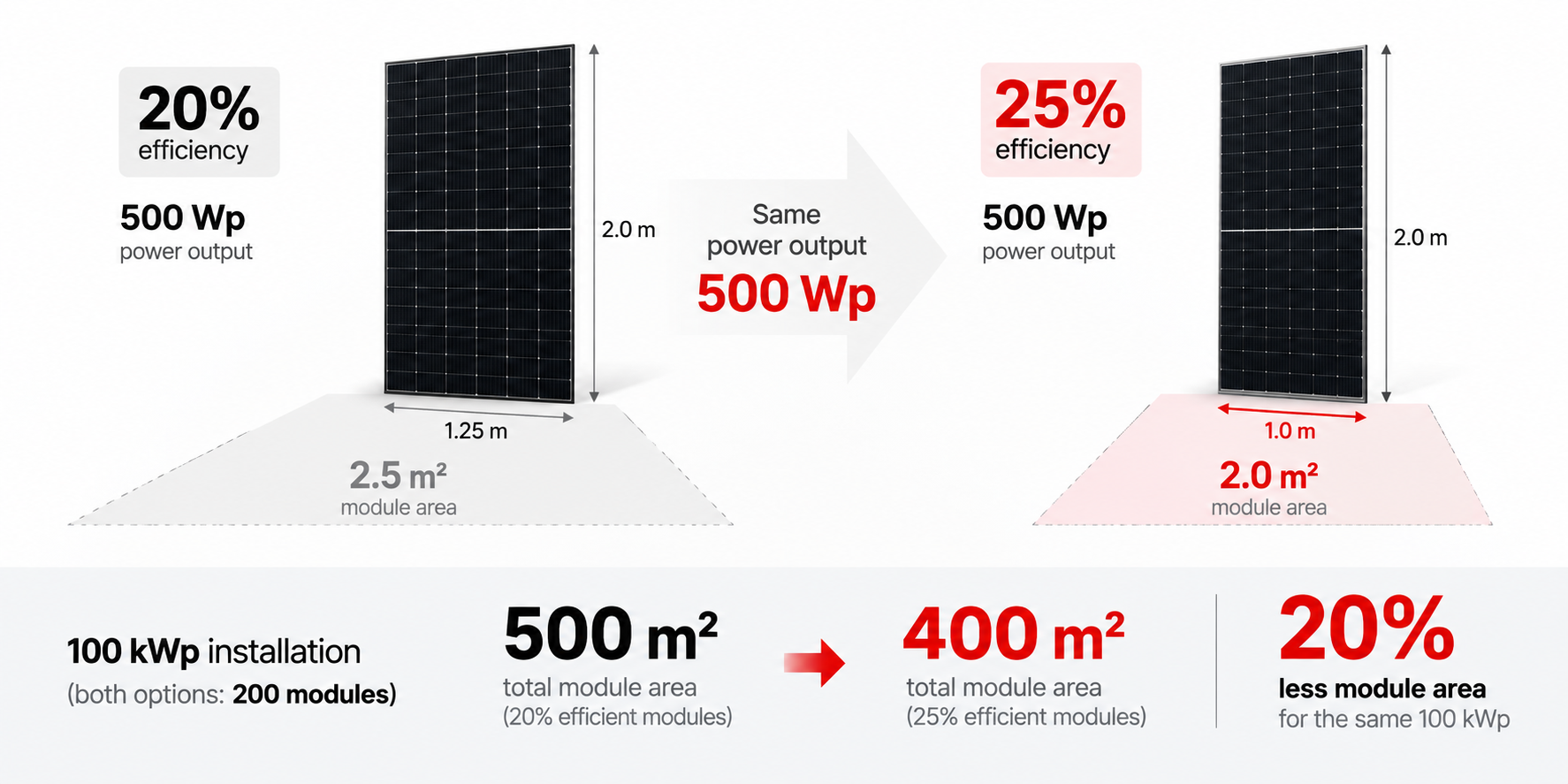
The difference becomes clear when comparing two modules with the same power rating. A 500 Wp module with 20% efficiency needs about 2.5 m² of surface area to generate its rated power under standard test conditions. If the efficiency increases to 25%, the module can deliver the same 500 Wp using only 2.0 m². In other words, manufacturers can achieve the same power output with a module that is 20% smaller. This matters because a smaller module generally needs less glass, aluminium and other materials.
For a larger solar installation with 100 kWp of capacity, this difference adds up. Since both module types deliver 500 Wp, the installation would require 200 modules regardless of their efficiency. What changes is the total surface area needed. The modules with 20% efficiency would cover approximately 500 m², whereas the 25% efficient modules would need only 400 m². This saves 100 m² of module surface area without reducing the installed capacity.
The 20% reduction in module surface area also creates opportunities to save materials during manufacturing. Smaller modules can require less glass, aluminium and encapsulation material, which can reduce production costs and associated carbon emissions. The actual savings depend on the module's construction and the manufacturing requirements of its solar cells, however.
Higher lifetime electricity generation can reduce carbon emissions per kWh
The environmental benefit of higher efficiency also depends on the electricity a module generates throughout its operating life. A module's lifecycle carbon footprint per kilowatt-hour shows how much CO₂ is emitted for every kilowatt-hour of electricity it produces over its lifetime.
In July 2025, the European Commission's Joint Research Centre (JRC) proposed a common method for measuring the carbon footprint of solar modules. The method accounts for emissions during manufacturing and other stages of a module's life, as well as the electricity it generates over time. The JRC estimates that the carbon footprint of solar electricity ranges between 10.8 and 44 g CO₂eq/kWh, depending on how the modules are manufactured and how much electricity they produce over their lifetime.
Higher-efficiency modules can produce more electricity from the same surface area. This can lower their carbon footprint per kilowatt-hour, provided the additional electricity makes up for any extra emissions during production.
A simple illustrative example shows the difference. Two solar modules of the same size each have a total lifecycle carbon footprint of 240 kg CO₂e. The first produces 15,000 kWh of electricity over its lifetime, resulting in 16.0 g CO₂e per kWh. The second produces 16,500 kWh, reducing its carbon footprint to approximately 14.5 g CO₂e per kWh. The second module generates 10% more electricity over its lifetime and has a carbon footprint per kilowatt-hour that is approximately 9% lower.
Lifetime performance influences the carbon benefit
Though it is a very good indicator, a module's rated efficiency alone does not determine how much electricity it will produce over several decades. Solar technology used, local sunlight, operating temperatures and degradation all influence lifetime output as well.
LONGi's back contact technology is designed to improve electricity generation under different operating conditions. By placing electrical contacts on the rear of the solar cells, the design eliminates front-side metal shading and allows more sunlight to reach the active cell surface. In addition, the new 0BB (zero busbar) architecture in all HPBC 2.0 back contact modules further supports efficient current collection.
Partial shading can also reduce electricity generation. LONGi's HPBC 2.0 modules use Shading Optimizer technology to limit power losses when parts of a module are shaded. In comparative testing by CPVT, the Hi-MO X10 recorded a power loss of 10.2%, compared with 36.5% for the TOPCon reference module under the tested shading conditions.
Another important factor is degradation, which describes how much a module's power output gradually decreases as it ages. LONGi's back contact modules covered by the EPD carry a 30-year power performance warranty. It specifies a maximum first-year loss of 1% and subsequent annual degradation of no more than 0.35%. At year 30, the warranted retained power is 88.85% of the original rating.
Together, these characteristics can help maintain high electricity generation throughout the module's operating life. They also support its environmental performance because higher lifetime electricity output can reduce the carbon footprint per kilowatt-hour.
The environmental performance of solar modules will become increasingly important as solar power expands worldwide. Higher efficiency can help manufacturers use resources more effectively and improve the carbon balance of solar electricity. LONGi's continued development of back contact technology demonstrates the role that module innovation can play in reducing the environmental impact of solar energy over its lifetime.

Lorem ipsum dolor sit amet, consectetur adipiscing elit. Suspendisse varius enim in eros elementum tristique. Duis cursus, mi quis viverra ornare, eros dolor interdum nulla, ut commodo diam libero vitae erat. Aenean faucibus nibh et justo cursus id rutrum lorem imperdiet. Nunc ut sem vitae risus tristique posuere.