Subscribe to the LONGi Newsletter

Partial shading is unavoidable on many solar installations. LONGi's Shading Optimizer uses the Weak Conduction Design of its back contact technology HPBC 2.0 to change the electrical response of individual cells when shading occurs. This reduces power loss and localised heating. TÜV Rheinland testing recorded hot-spot temperatures up to 60°C lower than the tested TOPCon modules, while TÜV Rheinland has confirmed Class A and A+ shading resistance for different Hi-MO X10 module series. The results show what this means for energy yield, module temperatures and long-term rooftop operation.
Partial shading is an electrical as well as a physical problem
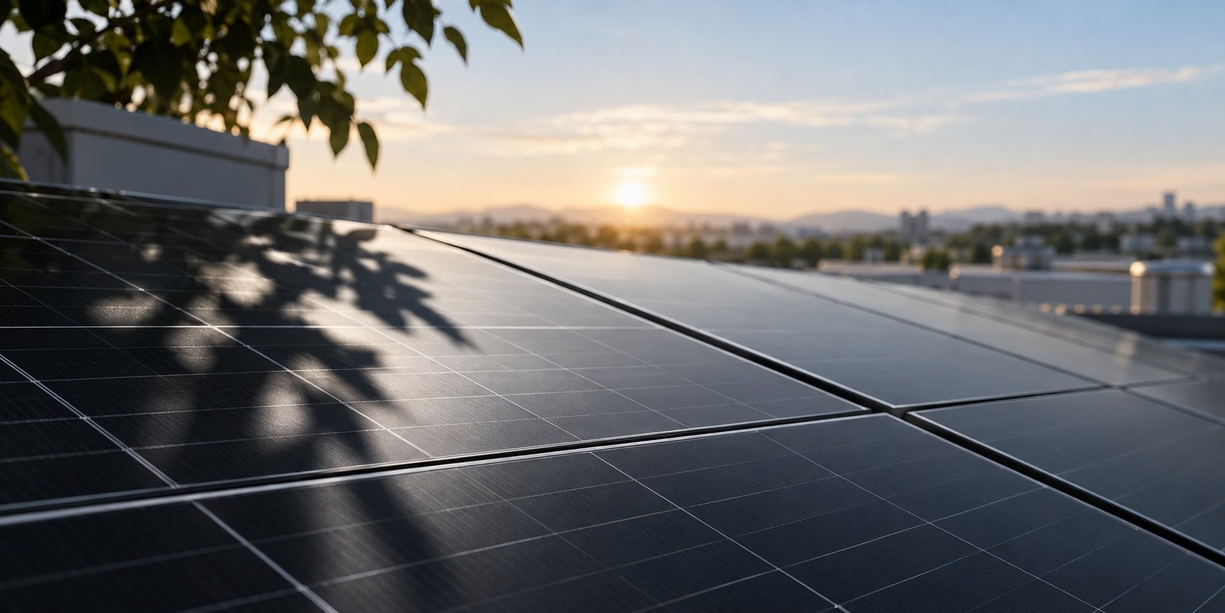
Leaves, dust, snow and bird droppings can temporarily cover individual cells, while chimneys, trees, ventilation systems and other rooftop structures create fixed or moving shadows. The shaded area itself may be small, but its electrical impact can be considerably larger.
Solar cells within a module are interconnected. When one cell or part of a cell receives less sunlight, it generates less current than the illuminated cells around it. This mismatch can reduce the output of more than the physically shaded area. Under certain conditions, the affected cell can also be driven into reverse bias and dissipate electrical energy as heat, creating a hot spot.
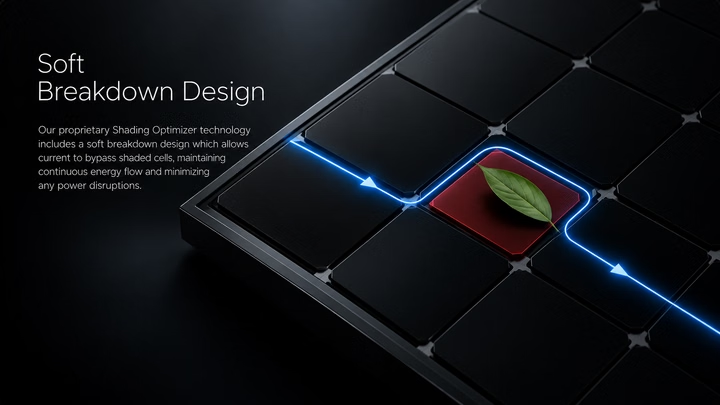
HPBC 2.0's back contact architecture provides the electrical basis for LONGi's Shading Optimizer. With both positive and negative contacts located on the rear of the cell, the architecture allows current to be managed through alternative paths. LONGi integrates its Weak Conduction Design and Soft Breakdown Design into the HPBC 2.0 cell structure, giving individual cells a bypass-diode-like function. In conventional modules, when a cell is shaded and restricts the flow of current, a bypass diode can redirect electricity around an entire group of interconnected cells. As a result, even cells that are fully exposed to sunlight can temporarily stop contributing to power generation. LONGi's Shading Optimizer addresses this problem at cell level. Instead of bypassing a whole group of cells, it provides an alternative path for current to pass through the affected cell, even when that cell receives less sunlight. This allows the surrounding, unshaded cells to continue generating electricity, reducing the overall power loss. At the same time, the alternative conduction path limits the build-up of heat in the shaded cell, reducing the risk of hot spots.
TÜV Rheinland confirms Class A and A+ shading resistance for Hi-MO X10 modules
TÜV Rheinland has confirmed Class A shading resistance for two Hi-MO X10 module series under its 2 PfG 2926/01.23 testing specification. A further module series, LR7-54HJBB, achieved Class A+ under the updated 2 PfG 2926/05.25 specification. These independent assessments verify the shading resistance of the respective module designs under defined test conditions.
In comparative testing under identical shading conditions, TÜV Rheinland also examined the thermal and electrical behaviour of HPBC 2.0 and TOPCon modules. Local temperatures on the tested TOPCon modules exceeded 160°C, while HPBC 2.0 remained at around 100°C, with hot-spot temperatures up to 60°C lower. HPBC 2.0 also showed significantly lower power attenuation under the same conditions.
CPVT testing shows 72% lower power loss for Hi-MO X10 under single-cell shading
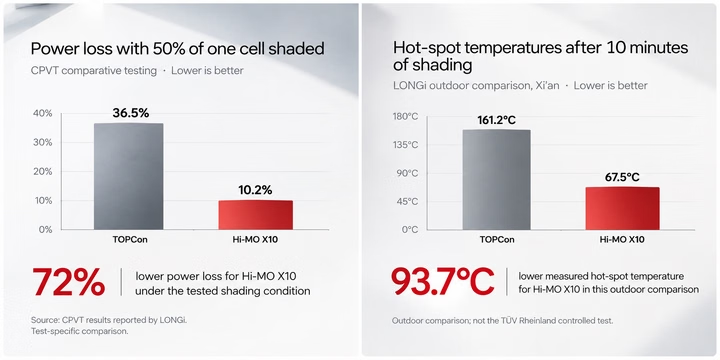
Separate testing by China's National Center of Supervision and Inspection on Solar Photovoltaic Product Quality, CPVT, quantified the effect on module output. When 50% of a single cell was shaded, Hi-MO X10 recorded an average power loss of 10.15%, compared with 36.48% for the tested TOPCon modules, representing approximately 72% lower power loss under the tested shading condition.
The comparison illustrates an important distinction. Some generation is inevitably lost when part of a cell no longer receives sunlight. The electrical mismatch created by the shaded cell, however, can reduce output beyond the physically shaded area.
The Shading Optimizer is designed to limit this wider electrical impact, allowing more of the unshaded part of the module to continue contributing to power generation.
Shading Optimizer also reduces thermal stress under partial shading
Beyond reducing power loss, the Shading Optimizer also addresses the thermal consequences of partial shading. Persistent or severe hot spots can place additional stress on module materials, accelerate degradation and affect long-term reliability.
Outdoor comparative trials provide a tangible example. In a LONGi outdoor comparison in Xi'an, two modules were installed side by side, with irradiance measured at 871.7 W/m² for Hi-MO X10 and 867.0 W/m² for the TOPCon reference. After ten minutes of deliberate shading, the measured hot-spot temperature reached 67.5°C on Hi-MO X10 and 161.2°C on the tested TOPCon module, a difference of 93.7°C. A second comparison recorded 70.2°C for Hi-MO X10 versus 161.2°C for TOPCon after ten minutes.
These outdoor comparisons are separate from TÜV Rheinland's controlled testing, but they show the same pattern: HPBC 2.0 restricts the severe localised temperature rise that can occur when part of a module is shaded.
Lower hot-spot temperatures help address one source of fire risk
Severe hot spots are not only a performance and reliability concern. When localised temperatures rise excessively, they can damage module materials and contribute to conditions that increase fire risk. By limiting temperature build-up under partial shading, LONGi's Shading Optimizer helps address one potential source of overheating within the module.
This preventive function is distinct from a module's fire resistance, which depends on its materials, construction and performance in dedicated fire tests. LONGi combines both approaches in its Hi-MO X10 Guardian Fire-Resistant module. Alongside HPBC 2.0's hot-spot control, the module incorporates fire-resistant glass and flame-retardant materials.
Its fire performance has been assessed under several international and European standards, achieving high classifications across different aspects of fire safety. Under UL 790, the module has received TÜV Rheinland-certified Class A, the highest rating for resistance to external fire exposure. The module has also undergone fire testing under IEC 61730-2 MST 23. In Europe, it has achieved Class B under EN 13501-1, indicating a very limited contribution to fire. Class B is currently regarded as the highest practically achievable rating for conventional PV modules. The module has also passed testing for B_ROOF(t4) under EN 13501-5, the highest classification under the t4 method for assessing the performance of roof systems exposed to external fire. The final classification certificate is currently being processed. Together, these results demonstrate strong fire performance across complementary safety requirements.
Shading performance as a measure of module resilience
As solar installations expand across commercial, industrial and residential rooftops, partial shading remains a common operating condition that cannot always be avoided through system design. How a module responds to these conditions therefore matters when assessing its expected energy yield and long-term reliability.
LONGi's Shading Optimizer demonstrates why shading resistance deserves greater attention when comparing solar technologies. Beyond rated power and efficiency under standard test conditions, a module's ability to maintain performance under less-than-ideal conditions is an important consideration for the long-term value of a PV installation.
More on the Hi-MO X10 Series which is based on HPBC 2.0 and a Shading Optimizer Technology.

Lorem ipsum dolor sit amet, consectetur adipiscing elit. Suspendisse varius enim in eros elementum tristique. Duis cursus, mi quis viverra ornare, eros dolor interdum nulla, ut commodo diam libero vitae erat. Aenean faucibus nibh et justo cursus id rutrum lorem imperdiet. Nunc ut sem vitae risus tristique posuere.