Subscribe to the LONGi Newsletter

A battery energy storage system (BESS) relies on several technologies to control charging, manage electricity and keep the battery safe. These technologies often come from different suppliers. Their software and controls must exchange information correctly so the battery can respond quickly and operate efficiently.
LONGi develops five key technologies in-house for its LONGi ONE portfolio for commercial and industrial (C&I) and utility-scale projects. This allows its engineers to design and test the systems together, with direct control over how they communicate. The approach is intended to support reliable operation and efficient energy use. It also gives customers one point of contact for technical support.
An integrated BESS architecture: Five key storage technologies developed in-house
Battery storage manufacturers take different approaches to system development. Some purchase major components and integrate them into a complete product. Others develop their own control technologies or use a solution in between.
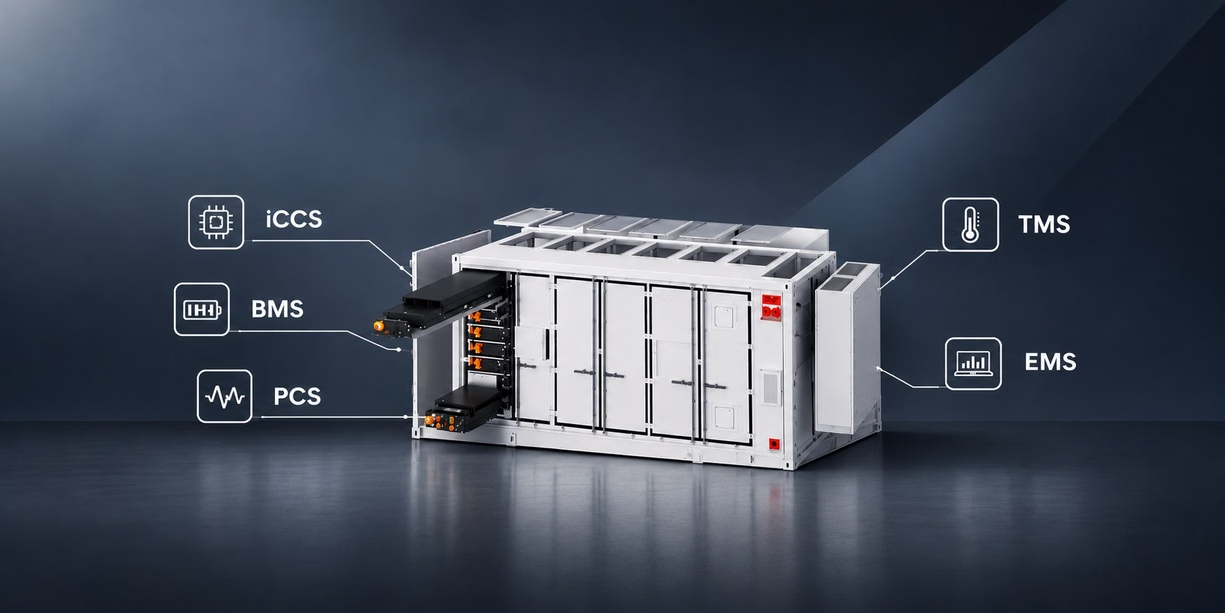
LONGi has made in-house development a central part of its energy storage business. Its integrated 5S architecture consists of five technologies:
- Battery management system (BMS): Monitors battery conditions and manages safe operation.
- Intelligent Cell Contact System (iCCS): Monitors individual battery cells and detects early signs of potential problems.
- Energy management system (EMS): Controls when the battery charges or discharges.
- Thermal management system (TMS): Maintains the battery within its required temperature range.
- Power conversion system (PCS): Converts electricity between the battery and the connected electrical system.
These technologies must work together during every charging and discharging cycle. The BMS provides information about the battery's condition, which the EMS uses to manage available energy. The PCS then controls the flow of electricity according to the system's operating requirements.
Developing these technologies in-house gives LONGi direct control over how they communicate.
Faster response and more accurate battery control
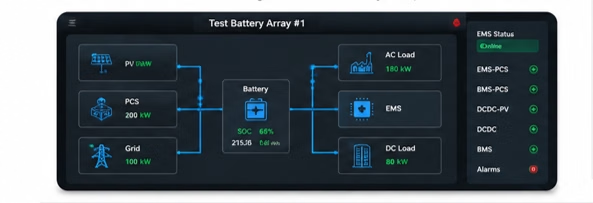
The benefits can be seen in how accurately the battery manages its stored energy and how quickly it responds to changes in electricity demand. LONGi's energy management system (EMS) has a specified response time of 70 milliseconds or less. This supports a fast response to changes in electricity demand, an important requirement for peak shaving. LONGi also specifies a conversion efficiency of at least 98% for its power conversion system (PCS). This helps limit electricity losses during power conversion.
The battery management system (BMS) estimates the battery's state of charge with an error of no more than 2.5%. This gives the EMS accurate information about how much energy is available. It can use this information to manage charging and discharging.
Temperature control also affects battery performance. LONGi's thermal management system (TMS) is designed to maintain stable operating temperatures and reduce uneven heating between cells. Effective temperature control helps protect battery performance and limit degradation over time.
LONGi's Intelligent Cell Contact System (iCCS) monitors individual battery cells. It measures cell voltage with an accuracy of ±3 mV and temperature with an accuracy of ±1°C. It also checks for early signs of problems, including electrolyte leakage and safety valve opening. This gives the battery management system more detailed information about cell conditions and supports early fault detection.
Fewer suppliers can simplify BESS maintenance and service
Battery storage systems need maintenance and software updates throughout their operating life. Technical problems can also occur, and identifying their cause is not always straightforward.
A 2024 study by EPRI, Pacific Northwest National Laboratory and TWAICE examined 81 reported battery storage incidents. Researchers identified the main cause in 26 cases. Problems involving system integration, assembly and construction accounted for 10 incidents, the largest individual category among cases with an identified cause.
The findings highlight the importance of proper system integration. They also show why technical problems cannot always be traced to the battery cells themselves.
When control technologies come from different suppliers, diagnosing a problem may require several companies to investigate their respective components. Each supplier has detailed knowledge of its own technology, but the cause may lie in how different systems interact.
With its key control technologies developed in-house, LONGi can investigate these interactions directly. Its engineers have access to the technologies involved and can examine how they operate within the complete storage system. This can simplify troubleshooting and reduce the need to coordinate with external technology developers.
LONGi ONE also provides a single point of contact for technical support. Its integrated C&I storage platform comes with a unified warranty. For EPCs and storage operators, this can make technical support easier to manage and provide clearer responsibilities. Specific warranty coverage and service obligations depend on the contract.
Integrated BESS development also matters after commissioning
The importance of system integration continues after a battery enters operation. Software changes can affect how different parts of the system work together, particularly when those technologies come from separate suppliers.
EPRI describes such a case in its 2024 Energy Storage Implementation Guide. A firmware update requested by a battery supplier caused problems with an inverter from another manufacturer. Insufficient communication and coordination between the companies contributed to the issue. EPRI recommends testing software changes and checking their effects on other parts of the system before implementation.
The example shows why software maintenance needs to consider the complete BESS. A change to one component may affect another, even if both operate correctly on their own.
With the main control technologies developed in-house, LONGi can coordinate these changes within its own engineering teams and test their effects across the integrated system. For customers, this means fewer external technology developers need to be involved when updates affect several components.
The same approach applies throughout the system's operating life. LONGi remains responsible for the core technologies and their integration, giving storage operators a single manufacturer to work with as their technical requirements change.

Lorem ipsum dolor sit amet, consectetur adipiscing elit. Suspendisse varius enim in eros elementum tristique. Duis cursus, mi quis viverra ornare, eros dolor interdum nulla, ut commodo diam libero vitae erat. Aenean faucibus nibh et justo cursus id rutrum lorem imperdiet. Nunc ut sem vitae risus tristique posuere.