Subscribe to the LONGi Newsletter

Installing solar panels on acommercial building is usually straight forward. But when that building standsless than 50 metres from a busy railway line, reflected sunlight becomes a potential safety concern.
For a Swiss car repair shop planning a 13-kW solar installation on its façade, this meant that theproject had to undergo a review by Swiss Federal Railways (SBB). The central question was whether reflections from the solar modules could affect traindrivers' visibility or railway signalling.
Meeting railway safety requirements with low-reflection solar
For Schoop+, the Swiss solar installer responsible for the project, the location presented an additional challenge when selecting suitable PV modules. Alongside energy performance and aesthetics, the company had to consider how sunlight reflected from the façade could affect nearby railway operations. Schoop+ therefore opted for LONGi EcoLife Anti-Glare modules, designed to reduce reflected light while maintaining high power output.
Located less than 50 metres from the railway, the installation required review and approval by Swiss Federal Railways (SBB). With the selected LONGi EcoLife Anti-Glare modules meeting the project's reflection-control requirements, the installation received SBB approval.
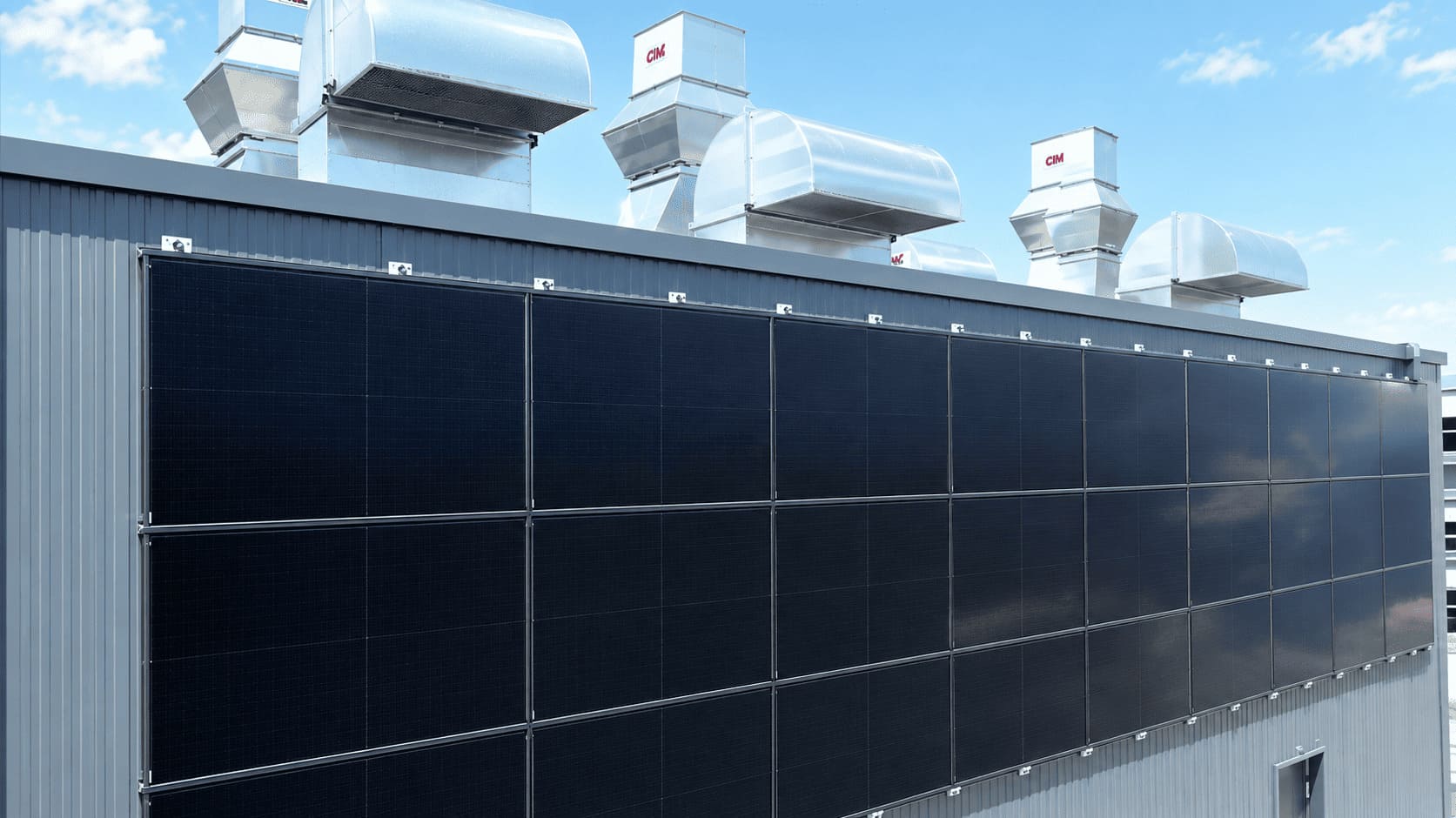
The approved installation comprises 27 LONGi EcoLife Anti-Glare modules with a total capacity of approximately 13 kW. Beyond their low-reflection properties, the modules' appearance was another deciding factor for Schoop+. Installed vertically along the building's side façade, they provide an additional electricity-generating surface while integrating into the building's exterior.
Vertical solar and the potential for winter generation in Switzerland
Switzerland's winter conditions offer an additional reason to consider vertical PV installations. Unlike modules mounted at shallow angles, façade-mounted panels are less prone to snow accumulation and can capture sunlight at favourable angles when the winter sun is low. Snow-covered surroundings may also contribute additional reflected irradiance, depending on the installation's orientation and surroundings.
Though vertical installations do not necessarily achieve the same annual yield as optimally tilted rooftop systems, they can offer a different seasonal generation profile. This makes façades an interesting option for commercial buildings seeking to expand theirsolar capacity, particularly where roof space is limited or additional winter electricity generation is desirable.

Lorem ipsum dolor sit amet, consectetur adipiscing elit. Suspendisse varius enim in eros elementum tristique. Duis cursus, mi quis viverra ornare, eros dolor interdum nulla, ut commodo diam libero vitae erat. Aenean faucibus nibh et justo cursus id rutrum lorem imperdiet. Nunc ut sem vitae risus tristique posuere.