.jpg)
Subscribe to the LONGi Newsletter

A field test conducted at the China Photovoltaic Testing Centre (CPVT) empirical base in Yinchuan, Ningxia, China, found that LONGi HPBC 2.0 modules recorded 1.51% higher cumulative specific yield than the tested TOPCon modules from 8 March to 31 August 2025. Thecomparison was conducted under outdoor conditions using ground-mounted systems without shading.
Two arrays compared under mid-temperate continental conditions
The ground-mounted test used a fixed tilt angle of 25°, with both arrays operating under unshaded conditions. Each array consisted of two modules. The HPBC 2.0 array used two 640W modules with an installed capacity of 1.28 kWp, while the TOPCon array used two 610W modules with a capacity of 1.22 kWp. Daily electricity generation was recorded and normalised against installed capacity to calculate specific energy yield(kWh/kWp).
From 8 March to 31 August 2025, HPBC 2.0 modules recorded a cumulative specific yield of 850.965 kWh/kWp, compared with 838.279 kWh/kWp for TOPCon modules, representing a 1.51% higher yield. Monthly comparisons showed that HPBC 2.0 maintained higher specific yield through outthe test period.
Located in Yinchuan, Ningxia, China, thetest site features a mid-temperate continental climate characterised by dryconditions, high solar irradiation and large day-to-night temperature variations. The test was conducted at CPVT’s outdoor empirical base, operated by China’s national centre for photovoltaic product quality inspection and testing and an IECEE-recognised CB laboratory. The facility conducts long-term monitoring of photovoltaic modules and related equipment under real operating conditions.
How HPBC 2.0 improves light utilisation
LONGi's HPBC 2.0 technology uses aback-contact cell architecture that places both positive and negative electrical contacts on the rear of the solar cell. This removes the metal gridlines found on the light-facing surface of conventional TOPCon cells, leavingmore of the front surface available to absorb sunlight.
HPBC 2.0 combines its back-contactarchitecture with a multilayer anti-reflection film and optimised cell surfacemicro-texturing, increasing short-circuit current by 2.25% and reducing short-wavelength light reflection by 12%. Its Bipolar Hybrid Passivation Technology further reduces electrical losses and increases the cell'sopen-circuit voltage. Together, these features improve light absorption and the conversion of incoming sunlight into electricity.
Monthly results show a sustained energy yieldadvantage
The monthly results provide further insight into the cumulative 1.51% advantage recorded during the test period. HPBC 2.0achieved higher specific energy yield in every reported month, with gains of 1.54% in March, 1.52% in April, 1.51% in May, 1.47% in June, 1.42% in July and 1.03% in August.
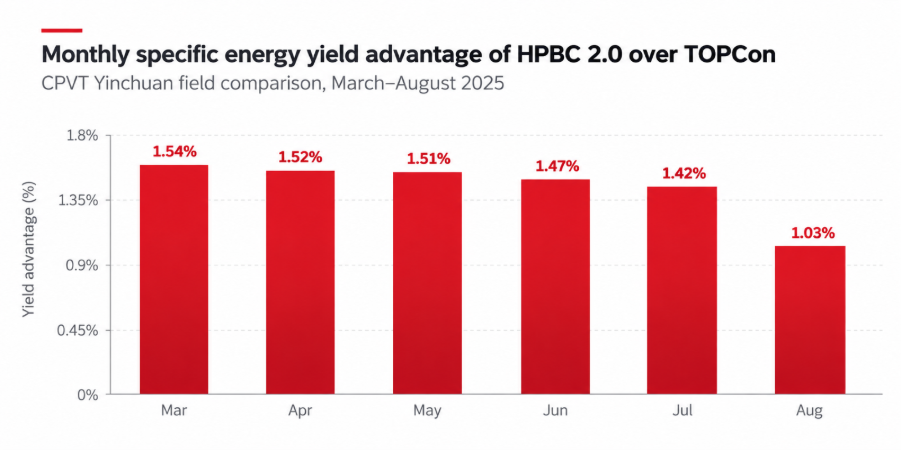
The advantage remained positive in every month. This provides a more detailed picture of performance. It shows that themeasured difference persisted across the spring and summer months at theYinchuan site.

Lorem ipsum dolor sit amet, consectetur adipiscing elit. Suspendisse varius enim in eros elementum tristique. Duis cursus, mi quis viverra ornare, eros dolor interdum nulla, ut commodo diam libero vitae erat. Aenean faucibus nibh et justo cursus id rutrum lorem imperdiet. Nunc ut sem vitae risus tristique posuere.