Subscribe to the LONGi Newsletter

Independent testing against European standard EN 17037 gives developers a documented basis for permitting decisions near airports and transport corridors
Airports, highways, rail networks, and logistics hubs across Europe hold millions of square meters of unused roof and surface area. A 2026 study by the European Commission's Joint Research Centre, published in Nature Energy, estimates that non-residential buildings across the European Union could host approximately 519 gigawatts of rooftop solar capacity. Vienna Airport covers about half of its annual electricity demand with onsite solar. Yet many comparable sites near transport infrastructure remain undeveloped, and the reason is rarely structural. Standard solar panels reflect sunlight at certain angles, and that reflection is what blocks permits near runways and busy transport corridors. Glare of that kind is the problem LONGi set out to address with the Hi-MO X10 Guardian Anti-Glare Pro, a module it put through independent glare testing so developers can bring documented reflection data to a permitting authority.
Glare can delay solar projects near transport routes
A conventional solar panel's smooth glass surface concentrates sunlight into a narrow, mirror-like beam under the right sun angle. The effect is called specular reflection, and it can briefly impair the vision of a driver or a pilot at the wrong moment. Reviewers weigh that hazard directly, so a solar array near an airport or a busy transport corridor is unlikely to clear a safety review if it throws specular glare in the wrong direction, whatever the roof's condition or size.
Pilots need unobstructed sightlines during takeoff and landing, and that requirement shapes how close solar installations can get to runways. National aviation authorities assess proposed layouts near airfields individually, and developers must show that an array will not directly reflect light into a flight path before construction can begin.
Europe has no single rulebook for glare, so every project gets assessed on its own
The European Union Aviation Safety Agency issues baseline guidance for solar installations near airports, but it does not grant or deny permits. That authority sits with national regulators, who apply their own review processes on a case-by-case basis. Because no unified European framework exists, a project near a major Dutch airport and a project near a regional German airfield go through separate assessments, often with different documentation requirements and different timelines.
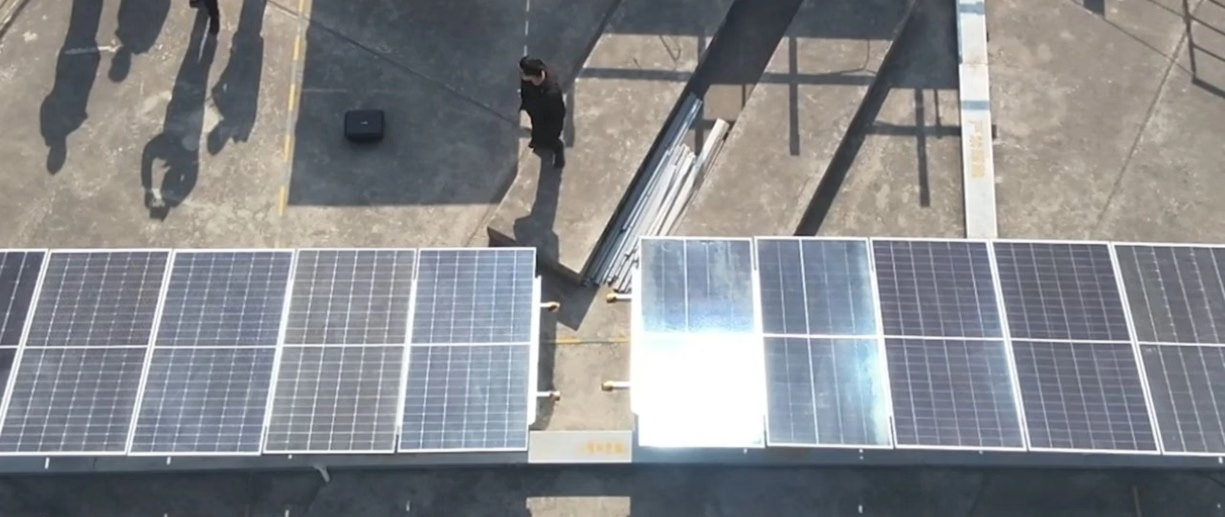
The difference between specular and diffuse reflection matters here. Textured glass scatters incoming light in many directions instead of concentrating it into one beam. The scattered light is far less intense at any single point, and that is the principle textured anti-glare glass has long relied on to reduce reflection complaints.
No outdoor glare standard exists, so testing borrows one built for buildings
Aviation and traffic authorities have not published a dedicated outdoor solar glare standard. In its absence, EN 17037, a standard originally written to assess daylight and glare inside buildings, has been adopted for solar modules instead. The fit isn't perfect, but it gives regulators a consistent, independently verifiable number to work with: the Daylight Glare Probability, a metric that scores how likely a given light source is to cause visual discomfort for someone looking at it.
TÜV Rheinland tested the Hi-MO X10 Guardian Anti-Glare Pro under this standard and recorded a Daylight Glare Probability rating of 0.29, placing it in the AAA classification, the highest band for imperceptible glare under EN 17037. A separate measurement by a Singapore SAC-certified OTM laboratory put its total reflectivity at approximately 0.9 percent, against roughly 2.9 percent for conventional module structures. For a developer preparing a permit application, both figures are something a reviewing authority can check against a known reference point, rather than a manufacturer's own claim. Together, they provide predictable, documented reflection behavior for installations near airports, transport corridors, and urban environments.
Textured glass historically reduced the power a panel could generate
Standard anti-glare glass solves the safety problem by scattering light, but scattering light also means less of it reaches the solar cells directly beneath the surface. Earlier generations of anti-glare modules gave up some of their energy output compared to standard panels with smooth glass. For a developer weighing a large commercial roof, that tradeoff mattered: solving the permitting problem could mean accepting a lower-yield system, which changes the project's return calculations.
Back-contact cell architecture recovers most of the energy lost to textured glass
The Hi-MO X10 Guardian Anti-Glare Pro pairs chemically etched, micro-structured anti-glare glass with LONGi's HPBC 2.0 back-contact cell technology. In a standard panel, metal contact fingers sit on the front of the cell and block a portion of incoming light. Back-contact design moves all electrical contacts to the rear of the cell, so the front surface is free to absorb light across its full area.
The two technologies address the historical tradeoff directly. The etched glass still scatters reflected light to solve the glare problem, and the back-contact cells recover much of the light-absorption loss that the textured surface introduces. The module is available in 54-cell and 66-cell formats.
Verified glare data changes what happens after a project is already built
A developer who can produce independent EN 17037 test data at the permitting stage has a documented basis for a reviewing authority's decision, instead of relying on a back-and-forth of site-specific glare studies that can add months to a project timeline. That matters most after the fact: national regulators can require an operator to replace installed modules if a completed array is later found to produce unmitigated glare. Independent, pre-verified test data is the record that shows a project was assessed correctly the first time, which is what keeps a permitting decision from being reopened after the panels are already on the roof.

Lorem ipsum dolor sit amet, consectetur adipiscing elit. Suspendisse varius enim in eros elementum tristique. Duis cursus, mi quis viverra ornare, eros dolor interdum nulla, ut commodo diam libero vitae erat. Aenean faucibus nibh et justo cursus id rutrum lorem imperdiet. Nunc ut sem vitae risus tristique posuere.