
Subscribe to the LONGi Newsletter

Armenia's solar sector has moved fast over the past two years, and the pace shows no sign of slowing. Solar power plants in the country reached a combined capacity of 1,141 megawatts by March 2026, split between 479 MW of industrial-scale plants and 662 MW of autonomous rooftop installations [1]. That total already surpasses the government's original 2030 target of 1,000 MW, four years ahead of schedule.
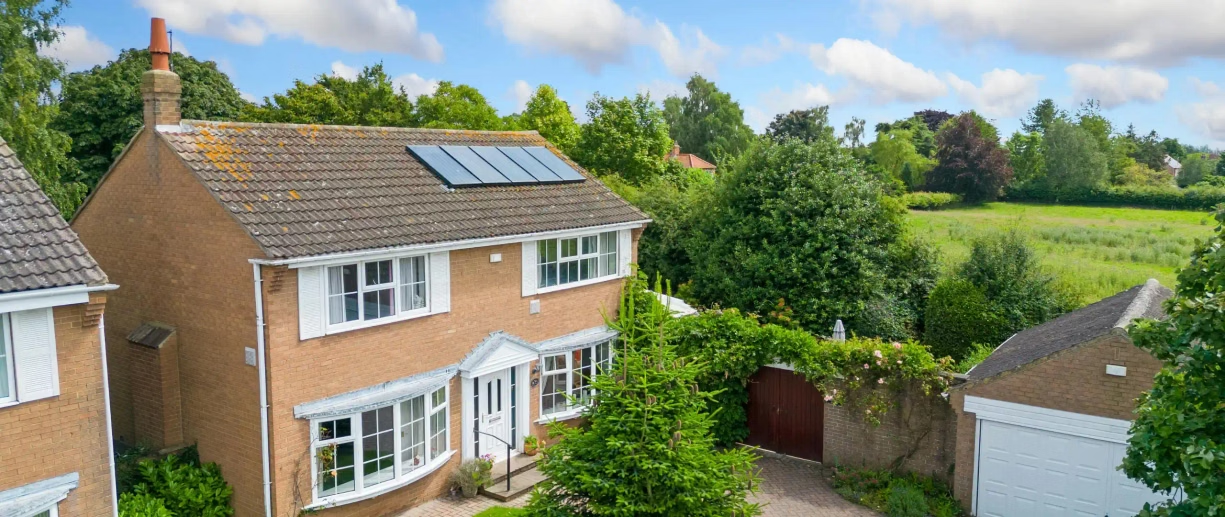
Much of that growth happened in a single year. Armenia added around 615 MW of solar capacity in 2025 alone, with household solar installations growing 60% year on year [2]. More than 50,000 autonomous solar producers now feed into the country's grid, and solar already accounts for roughly 15% of national electricity generation [2]. The government's long-term energy strategy aims to raise the share of renewables in the power mix to around 50% by 2030 and 60% by 2040, with solar and wind capacity expected to reach 2 GW by 2040 [2]. Local solar distributor Sunhit aims to support that goal by strengthening its partnership with LONGi.
Strong irradiation and policy support make Armenia an attractive solar market
Armenia's energy mix is under structural pressure, with natural gas remains the dominant source of generation [3]. Solar energy offers a way to diversify supply, reduce import dependence, and meet rising demand from residential, commercial, and industrial users alike.
Armenia benefits from strong solar irradiation, which improves the economics of rooftop and ground solar projects. The government has backed this potential with policy support, including cashback incentives for residential installations, a net metering scheme, and a series of tenders for utility-scale plants such as the operational Masrik-1 facility (55 MW) and the Ayg-1 project (200 MW) now under development [4].
For a landlocked market with limited domestic manufacturing, that combination of favorable conditions and clear policy direction has attracted growing interest from technology providers looking to support the next phase of Armenia's solar buildout.
LONGi and Sunhit expand partnership to deliver advanced technology with local expertise
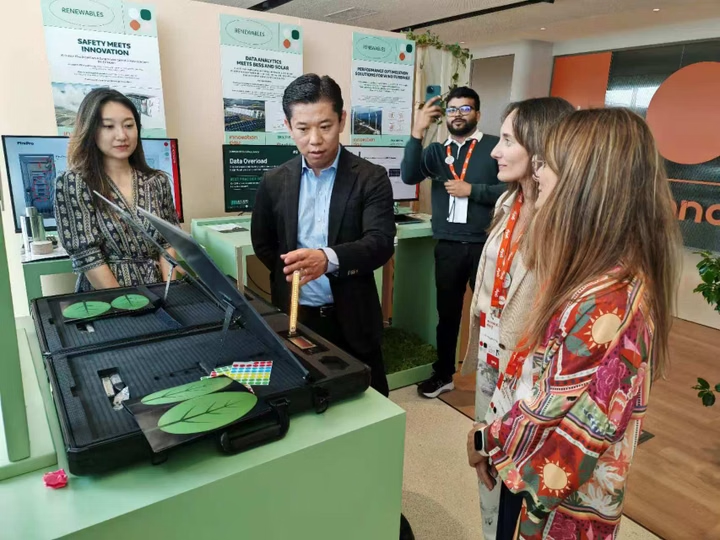
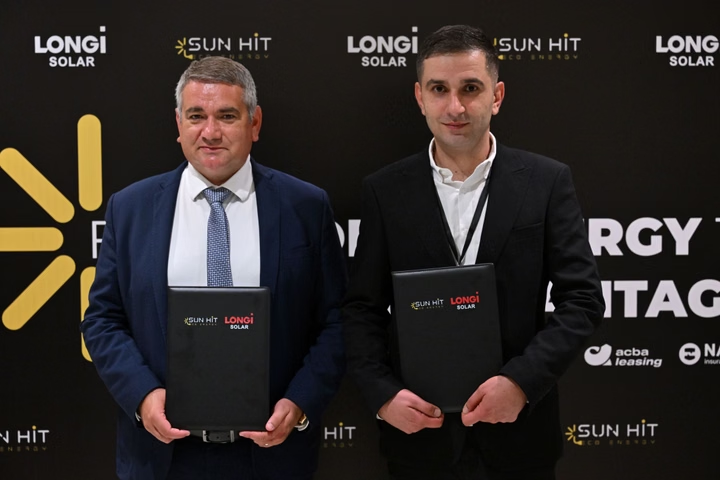
LONGi Solar is reinforcing its position in this market through its strategic partnership with Sunhit, the company's authorized partner in Armenia and a certified solar distributor and engineering partner. In July, representatives from both companies met in Yerevan to hold discussions with business leaders, institutional stakeholders, and academic partners. The visit concluded with the signing of Memorandum of Understanding, reaffirming Sunhit's role as LONGi's official partner in the country.
The signing reflects Sunhit's track record since its founding in 2024. Its team, with more than a decade of combined experience in solar system design and installation, has already delivered solar power plants with a combined capacity exceeding 15 MW across Armenia.
"Armenia's solar market has grown faster than almost anyone expected, and that creates real opportunity for technology that performs well under the country's specific conditions," said Adrian Kočan, General Manager of LONGi Solar Eastern Europe (DG). "Our renewed partnership with Sunhit gives us the local expertise to bring that technology to Armenian businesses, not just on paper."
"Armenian customers are becoming more sophisticated in what they expect from a solar investment. They want efficiency, reliability, and a partner who understands local conditions," said Tigran Vardanyan, Founder and CEO of Sunhit. "Working with LONGi gives us access to technology that matches that demand, and a partnership that has supported our growth from the beginning."
HPBC 2.0 technology optimizes project economics and land use in space-constrained markets
The introduction of LONGi's HPBC 2.0 (Hybrid Passivate Back Contact) technology is central to the partnership between LONGi Solar and Sunhit. It will be available through LONGi's flagship module, Hi-MO X10, which is designed for commercial and distributed generation applications. LONGi's broader portfolio includes not only HPBC 2.0 but also LONGi BLOCK, a containerized mobile PV solution offering a fast deployment option for sites facing grid connection delays or temporary power needs.
By relocating all electrical contacts to the rear of the cell, HPBC 2.0 removes front-side shading entirely, increasing the active surface area exposed to sunlight. The result is a module rated up to 670 W, with a module efficiency of 24.8% and a cell efficiency of 26.6%, alongside a low annual degradation rate of 0.35%.
For a market where commercial and industrial applications are taking up a growing share of new solar capacity, that level of efficiency translates directly into better land use and stronger project economics, both relevant considerations in a country where available space and grid capacity are limited.
The introduction of LONGi ONE, the company’s integrated solar-plus-storage system, is also planned, signaling a broader ambition beyond solar modules alone as the Armenian market starts to look at storage as the next step in its energy transition.
Armenia transitions from rapid capacity expansion to high-quality solar deployment
With installed capacity already ahead of government targets and demand for higher-performance systems rising, Armenia's solar market is entering a more mature phase, one where technology choice and installation quality matter as much as raw capacity growth. Through its renewed partnership with Sunhit, LONGi is positioning itself to support that shift, combining high-efficiency back contact technology with local engineering expertise built specifically for the Armenian market.
Sources: [1] Public Services Regulatory Commission of Armenia, via Armenpress, April 2026 [2] pv magazine International, "Armenia adds around 615 MW of solar in 2025," February 2026 [3] International Energy Agency, Armenia Energy Profile [4] German Economic Team, "Armenia's energy sector, current developments and challenges"

Lorem ipsum dolor sit amet, consectetur adipiscing elit. Suspendisse varius enim in eros elementum tristique. Duis cursus, mi quis viverra ornare, eros dolor interdum nulla, ut commodo diam libero vitae erat. Aenean faucibus nibh et justo cursus id rutrum lorem imperdiet. Nunc ut sem vitae risus tristique posuere.