
Contact info
Nadine Bütow
Head of Corporate Communications, LONGi Distributed Generation Europe
nadinebuetow@longi.comSubscribe to the LONGi Newsletter

LONGi introduced eight new photovoltaic technologies at its 2026 PV and Energy Storage Innovation Technology Launch on 14 July 2026 in Shanghai. The technologies reach across solar cells, modules, hardware and an energy-management platform. Each one can be used on its own, and combinations of them make customised products and solutions for different customer scenarios.
The clearest measure of what the technologies do together comes from a standard module of 2,382 mm by 1,134 mm. LONGi reports that all eight combined take module power above 690 watts at a conversion efficiency of 25.54 percent. Li Zhenguo, Founder and CTO of LONGi, presented the full set at the launch and said the company can combine the technologies "to build targeted products and solutions that resolve customers' core pain points".
Zhong Baoshen, Chairman and General Manager of LONGi, told the launch that technological innovation is the first principle of the PV industry. "Only technological innovation can pull the PV sector out of vicious price competition and unlock sustained growth potential," he said. At the launch the eight technologies were presented together under the name Technology Forest.
ACM gridline technology halves cell resistance and adds up to 0.3 percent to mass-production efficiency
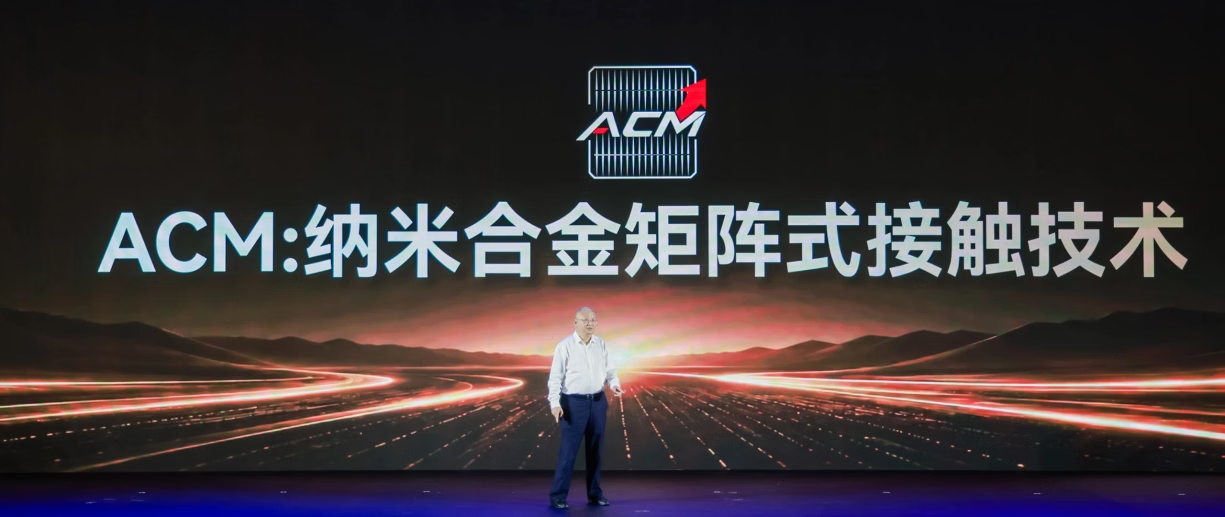
ACM, short for Advanced Contact Matrix, is a gridline technology LONGi developed in-house that improves both efficiency and reliability through changes to the gridline material and the way it is applied. The material uses a patented nano-alloy with a nano-scale anti-oxidation surface treatment, which halves the electrical resistance of the gridlines compared with conventional TOPCon products. Lower resistance widens the conductive channels and lets more current move out of the cell.
The process side separates the two jobs a gridline does. A current-collection layer keeps the contact area small to limit recombination loss, while a transmission layer carries the current out evenly. In Hi-MO 9 and Hi-MO X10 modules, ACM adds 0.2 to 0.3 percent to mass-production conversion efficiency and supports a module power rating up to 672 watts. The welding area on the primary busbars is doubled, and with the straight-line welding that BC cells allow, the usual risks of cold solder joints and broken gridlines are largely removed. The anti-oxidation coating keeps air and moisture from oxidising the contact, so output holds steady across the module's service life.
The three-in-one Conductive Backsheet Technology removes the solder ribbon modules have relied on for two decades
Integrated Conductive Backsheet Technology replaces the solder ribbons that PV modules have used for about twenty years. LONGi's own backsheet takes the rear encapsulant film and the conductive ribbon and rolls them into the backsheet itself, so one component carries the current and seals out moisture, with the insulation built in.
The design swaps the point contacts of a traditional solder ribbon for a full-area metal foil contact across the back of the cell. That full-area contact widens the current transmission cross-section by more than 85 percent. It also lowers mechanical stress on the cell by 60 percent, and the sealed foil construction cuts water vapour permeability by 90 percent. Because the foil is reflective, long-wavelength light that would otherwise pass straight through the silicon is bounced back into the cell for a second pass, adding 3 to 5 watts to the output of a single module.
Three connection technologies turn dead gaps and shaded busbar areas into working surface
A further group of technologies changes how the cells are joined and laid out inside the module.
Shingled Cell Technology overlaps neighbouring cells by 0.4 mm at the edge, so the 2 to 3 mm gaps of a conventional layout become active generating area. That adds about 2 percent to a module's effective generating surface.
Hidden Busbar Technology moves the busbars to the rear of the module. Nothing shades the front any longer, and the light-absorbing area grows by a further 1.1 percent.
Selective Temperature Alloy Connection, or STAC, works with the grid-free front of BC cells. A low-temperature fusion bond releases thermal stress, so the joints hold up through the temperature swings of an outdoor installation.
Between them, the three technologies widen the area that actually generates power and relieve the internal stress that leads to microcracks and cell breakage.
LONGi One OS energy-management platform recalculates charge and discharge every 15 minutes to raise storage returns
LONGi One OS is an energy-management platform that LONGi rolled out at SNEC 2026 for sites that bring together PV, storage, EV charging and load management. The platform draws on live electricity market prices, PV generation forecasts, load predictions, weather data and a site's own consumption history. A built-in AI agent works out an optimal charge and discharge plan every 15 minutes, so a storage asset earns as much as the market allows. The same platform handles remote operating guidance and flags faults early, which LONGi says lifts operation and maintenance efficiency by 90 percent.
Smart Modules recover 5 to 30 percent of generation on partly shaded arrays
Smart Modules carry a dedicated Maximum Power Point Tracking (MPPT) unit on each module, which removes the bucket effect caused by partial shading and lifts generation by 5 to 30 percent under shaded conditions. A rapid shutdown function brings the DC voltage down to a safe level below 30 volts within 20 seconds to reduce fire risk. Each module reports to the LONGi Smart PV app for live monitoring and quick fault location, which cuts O&M workloads. TÜV SÜD certified the technology as an official Smart PV Module in 2025, and it is ready for mass production. The global launch is set for Brazil on 25 August 2026, with volume delivery from October.
Hi-MO X10 Pro modules pair ACM with an anti-dust design at 24.7 percent efficiency and 670 watts
Hi-MO X10 Pro modules combine ACM technology with a full anti-dust coating and a reworked frame that supports both horizontal and vertical mounting while keeping dust off the glass. They reach a conversion efficiency of 24.7 percent and a power rating of 670 watts.
LONGi holds 510 BC patents and targets more than 100 GW of BC shipments by the end of 2026
Professor Shen Wenzhong, Director of the Institute of Solar Energy at Shanghai Jiao Tong University and a consultant to the China Photovoltaic Industry Association, set the back-contact approach in context at the launch. He described BC cells as highly scalable, with a theoretical efficiency ceiling of 29.1 percent, and pointed to their reliability and their fit across different installation settings. LONGi committed fully to BC technology in 2023 on that basis. By the end of 2025 it held 510 authorised BC-related patents, 330 of them invention patents, and it is targeting global BC module shipments above 100 GW by the end of 2026.

Lorem ipsum dolor sit amet, consectetur adipiscing elit. Suspendisse varius enim in eros elementum tristique. Duis cursus, mi quis viverra ornare, eros dolor interdum nulla, ut commodo diam libero vitae erat. Aenean faucibus nibh et justo cursus id rutrum lorem imperdiet. Nunc ut sem vitae risus tristique posuere.