Subscribe to the LONGi Newsletter

A comparative field test in Yinchuan, China, provides new performance data for LONGi HPBC 2.0 back contact technology under winter and partial-shading conditions. The test recorded a 1.39% energy yield advantage over conventional TOPCon modules under unshaded conditions. The relative advantage increased to 79.43% during snowy weather and reached 31.61% under artificially induced cylindrical shading.
Yinchuan field test examines BC performance under winter conditions
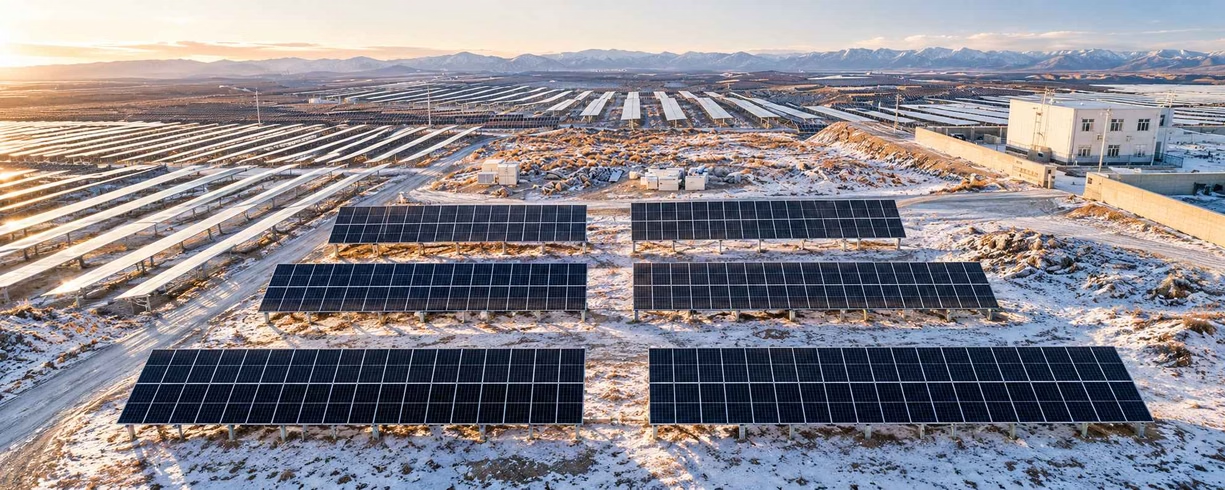
Located in the Ningxia Hui Autonomous Region in northwestern China, Yinchuan experiences a continental climate characterised by cold, dry winters and substantial seasonal temperature variations. Snow-covered ground can increase reflected solar radiation, while snow accumulation on module surfaces can temporarily reduce electricity generation.
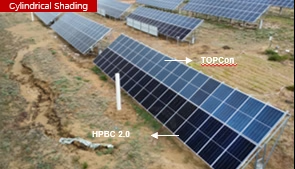
At the Yinchuan empirical testing site, LONGi HPBC 2.0 back contact modules and conventional TOPCon modules were installed on identical tracking systems over highly reflective ground, according to the project description. The test examined electricity generation under three conditions: normal operation without shading, natural snowy weather and artificially induced cylindrical shading.
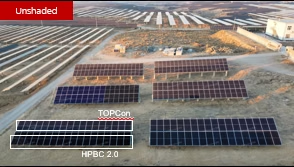
Field measurements show higher BC output under snow and shading
The field comparison examined how LONGi HPBC 2.0 back contact modules and conventional TOPCon modules responded to changing environmental conditions. During snowy weather, snow accumulation can temporarily obstruct incoming sunlight and reduce electricity generation. The observed differences in energy yield indicate that BC and TOPCon modules responded differently to the winter conditions recorded at the Yinchuan test site.
The cylindrical shading test introduced a localised obstruction to evaluate the impact of partial shading on BC and TOPCon module performance. The comparison provides further evidence of differences in shading resistance between the two solar cell technologies.
The findings reflect the specific test conditions in Yinchuan and should not be interpreted as average annual energy yield advantages for BC over TOPCon.
Back contact cell architecture helps reduce losses under partial shading
LONGi HPBC 2.0 technology uses a back contact cell architecture that places both positive and negative electrical contacts on the rear of the solar cell. By eliminating conventional front-side metal gridlines, the design increases the active surface area available for sunlight absorption and supports higher energy conversion efficiency.
The technology also incorporates Shading Optimizer technology based on a weak-conduction design, which improves the module's response to partial shading. When a section of a solar cell receives less sunlight, the affected area can restrict current flow and reduce the output of other cells connected in series. HPBC 2.0's cell-level design allows current to bypass locally shaded cell areas which helps to reduce power losses and the risk of excessive localised heating.
The Yinchuan cylindrical shading results are consistent with the expected benefits of this design. Snow-related performance differences may also depend on the distribution and duration of snow coverage, reflected irradiance and other operating conditions.
Further field tests confirm BC energy yield advantages over TOPCon
The Yinchuan findings complement other LONGi performance comparisons under different environmental conditions. In Sanya, China, HPBC 2.0 modules demonstrated up to 14.96% higher energy yield than TOPCon under shading. An offshore field test in Yantai recorded a 2.43% cumulative specific energy yield advantage for LONGi HPBC 2.0 modules under coastal operating conditions.

Lorem ipsum dolor sit amet, consectetur adipiscing elit. Suspendisse varius enim in eros elementum tristique. Duis cursus, mi quis viverra ornare, eros dolor interdum nulla, ut commodo diam libero vitae erat. Aenean faucibus nibh et justo cursus id rutrum lorem imperdiet. Nunc ut sem vitae risus tristique posuere.