Abonnieren Sie den LONGi Newsletter

Rooftop solar is set to become an increasingly familiar feature of UK homes. Under the government’s 2026 Warm Homes Plan, up to three million additional homes could receive solar panels by 2030, supported by measures designed to make clean energy technologies more accessible to households.
Knowing that solar is a good idea and choosing the right panel for your own home are two very different things. For most homeowners, the decision relies on advice from trusted installers. For an installer, that decision is informed by professional experience and ultimately comes down to a simple question: what would I trust for my own home?
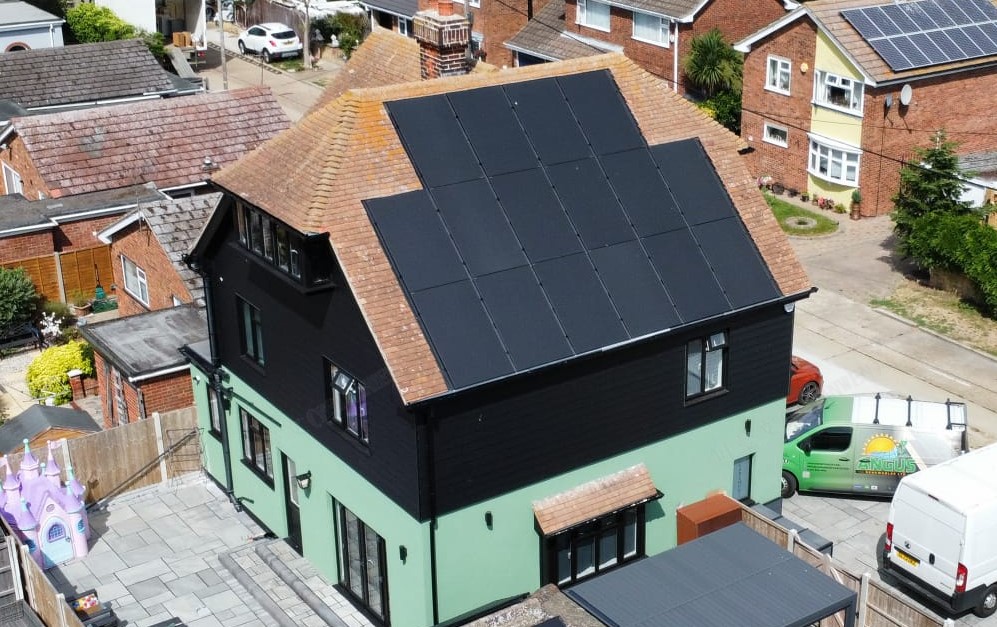
Jane Angus, founder of UK solar installer Angus Renewables, faced exactly that decision when selecting the modules for a 9.3 kW solar system at her own property. For Jane, energy generation was only part of the decision. The roof is highly visible, which made both the appearance of the finished system and the level of reflected light important considerations. LONGi Anti-Glare Pro combines a sleek, uniform appearance with a specialised low-reflection surface designed to minimise visible glare and help the modules integrate naturally with the property. The technology is already deployed in glare-sensitive environments, including installations near airports, where controlling reflected light is critical to safe operations.
“We chose the Anti-Glare panels primarily because of their premium appearance and sleek aesthetics,” Jane says. “As the system is installed in a visible location on our property, it was important that the panels complement the building’s overall look.”
The modules’ completely matt appearance supports exactly that objective: reflections are minimised, while the uniform, understated surface allows the solar installation to sit naturally within the overall appearance of the property. Jane’s 9.3 kW system is the UK’s first residential installation featuring LONGi Anti-Glare Pro.
How Anti-Glare Pro controls reflected light
The low-reflection appearance of Anti-Glare Pro is the result of an integrated approach to light management at both glass and cell level.
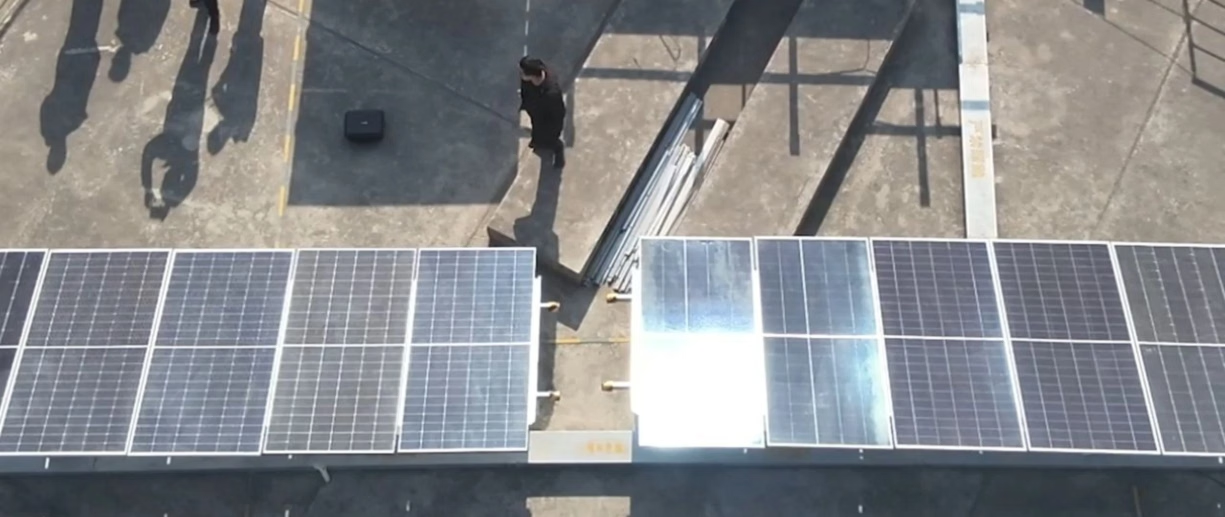
At the surface, micro-structured anti-glare glass changes the way sunlight is reflected. Instead of allowing reflected light to concentrate into bright spots, the structure diffuses it across a wider area, reducing the intensity of visible glare while maintaining high light transmission into the module. Beneath the glass, LONGi’s back contact cell architecture further improves light capture.
The effect can be measured. Under defined laboratory conditions, total reflectivity was reduced to approximately 0.9%, compared with around 2.9% for conventional module structures tested under the same conditions. Additional testing by the China Photovoltaic Testing Center (CPVT) found glare brightness to be reduced by up to 78% compared with conventional module designs.
Independent testing by TÜV Rheinland further confirms the module’s anti-glare performance. Anti-Glare Pro achieved a maximum Daylight Glare Probability (DGP) of 0.29 under EN 17037, corresponding to the highest AAA classification for imperceptible glare under the applied evaluation methodology.
For a highly visible residential roof such as Jane Angus’s, these characteristics have a tangible effect. Less concentrated reflected light means less visual glare, while the uniform, low-reflection surface gives the finished installation the understated appearance that was central to her choice.
Back contact technology for changing UK light conditions
At the heart of Anti-Glare Pro is LONGi’s HPBC (Hybrid Passivated Back Contact) technology, LONGi’s proprietary approach to back contact solar cell design. Unlike conventional solar cells, where metal contacts run across the front surface, HPBC moves the electrical contacts to the rear of the cell. This eliminates front-side grid-line shading and leaves a larger active surface available to capture incoming sunlight.
This architecture helps the module make effective use of available light, an important consideration in the UK, where irradiation levels and light conditions vary considerably throughout the day and across seasons. The unobstructed cell surface increases light absorption, while HPBC’s light-management and passivation design supports efficient conversion of the sunlight reaching the cell.
In Anti-Glare Pro, the cell and glass technologies work together. The micro-structured glass manages reflected light at the module surface while maintaining high light transmission, and the HPBC cells beneath capture and convert the transmitted light. With no visible front-side contacts, HPBC also contributes to the module’s clean, uniform appearance behind the completely matt glass.
For Jane’s highly visible roof, the two technologies work towards complementary goals: effective use of available solar energy and the clean, uninterrupted appearance she wanted for her home.
A professional choice for a personal project
For Jane, the finished installation has exceeded expectations.
“The anti-glare panels have exceeded our expectations in every respect,” she says. “From an aesthetic perspective, they look fantastic and blend seamlessly with the property, giving the installation a high-end, professional appearance.”
For Angus Renewables, the installation is also a working example of the technology the company can show to its own customers. And for Jane, it answers the question at the heart of the project: what would a solar professional choose for her own home?
Her choice was LONGi Anti-Glare Pro.
Review the whole story here:

Lorem ipsum dolor sit amet, consectetur adipiscing elit. Suspendisse varius enim in eros elementum tristique. Duis cursus, mi quis viverra ornare, eros dolor interdum nulla, ut commodo diam libero vitae erat. Aenean faucibus nibh et justo cursus id rutrum lorem imperdiet. Nunc ut sem vitae risus tristique posuere.