
Contact info
Nadine Bütow
Head of Corporate Communications, LONGi Distributed Generation Europe
nadinebuetow@longi.comSubscribe to the LONGi Newsletter

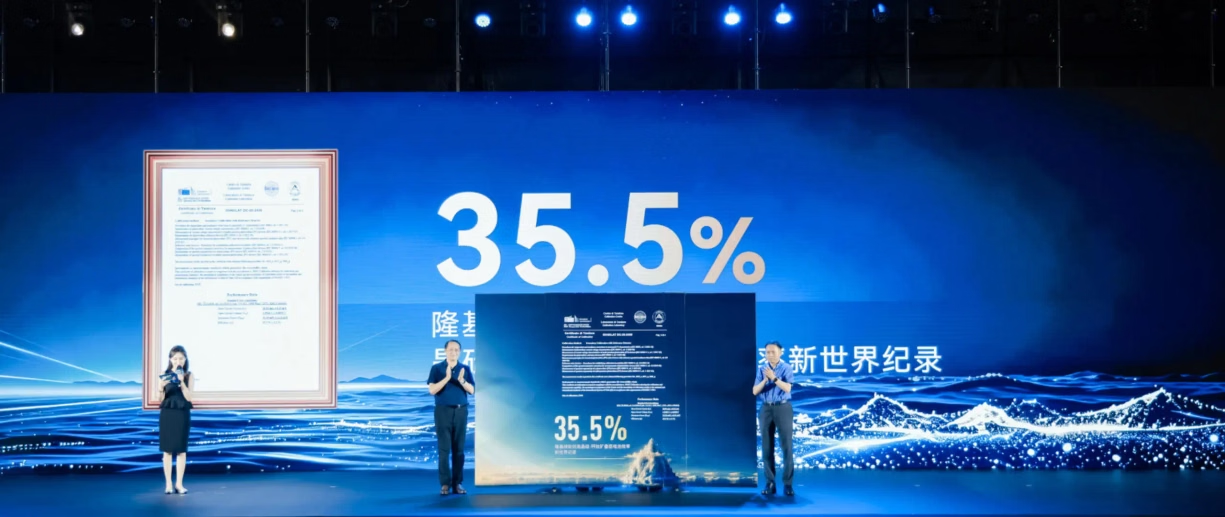
LONGi has reached a cell conversion efficiency of 35.5 percent with the company's independently developed crystalline silicon-perovskite tandem solar cells, certified by the European Solar Test Installation (ESTI). The result, presented at the 2026 Solar and Energy Storage Innovation Conference on 14 July 2026, is a new world record for the technology. Crystalline silicon-perovskite tandem cells are the mainstream technology route toward next-generation high-efficiency cells, with a theoretical efficiency limit of up to 43 percent, above the Shockley-Queisser limit of 33.7 percent that caps a conventional single-junction cell.
The 35.5 percent figure is the latest in a sequence of certified results. The team recorded 33.9 percent in November 2023 and 34.6 percent in June 2024. In less than a year after that, it moved from 34.85 percent through 35.2 percent to the current figure. LONGi's Central Research Institute produced the work.
In May 2026, LONGi's two-terminal crystalline silicon-perovskite tandem cell efficiency of 35.2 percent entered the 68th edition of the Solar Cell Efficiency Tables, compiled by the group led by Professor Martin Green at the University of New South Wales in Australia. On areas closer to industrial-scale dimensions, the cell reached 34.3 percent on 261 cm² and 32.2 percent on 274 cm². LONGi's tandem modules recorded 31.4 percent and 29.4 percent, both certified by independent international institutions and listed in the same tables.
Structured pipeline at LONGi accelerates the transition of tandem cell technology to industrial manufacturing
LONGi organizes its cell development as a tiered pipeline, keeping one generation in mass production while the next is already in development and a further generation is held in reserve. The structure lets the team turn successive laboratory gains into certified results at cell and module level, and it supports moving crystalline silicon-perovskite tandem technology from the laboratory toward industrial production.

Lorem ipsum dolor sit amet, consectetur adipiscing elit. Suspendisse varius enim in eros elementum tristique. Duis cursus, mi quis viverra ornare, eros dolor interdum nulla, ut commodo diam libero vitae erat. Aenean faucibus nibh et justo cursus id rutrum lorem imperdiet. Nunc ut sem vitae risus tristique posuere.